
 Careers
Retirement Planning for Cashiers
As a cashier, you earn a U.S. median of about $29,000 a year. Retirement can feel far off — or even out of reach — on that income, but a comfortable one is very doable if you use the right account and start the habit early. Here's a plain-English, no-jargon plan for cashiers.
Your typical retirement setup
Most cashier jobs don't come with a retirement plan, so the responsibility — and the opportunity — is yours. The best starting point is a Roth IRA you open yourself: you contribute after-tax dollars now while your tax rate is low, and every dollar of growth later comes out tax-free. If your employer does offer a 401(k) with a match, grab that first.
The Saver's Credit: free money for saving
Here's a benefit most people in this income range miss. If your household income is modest, the IRS gives you the Saver's Credit — a tax credit worth 10%, 20%, or even 50% of what you put into a retirement account (up to a limit), on top of the account's own tax advantages. You contribute to a Roth IRA or a 401(k), file IRS Form 8880, and the government effectively chips in. It's one of the best deals in the tax code, and it's aimed squarely at working people.
What to watch as a cashier
- Start tiny, but start now. Even $20–$40 a paycheck compounds into real money over decades. When you're starting out, the habit matters far more than the amount.
- Automate it. Set up an automatic transfer to your Roth IRA every payday so the money is saved before you can spend it.
- Move up when you can. Cashier roles are a foot in the door — a promotion to shift lead or a job with benefits can add a 401(k) match to the mix.
Even small amounts add up
You don't need a big salary to end up with a real nest egg — you need time. Here's what setting aside about 10% of a $29,000 salary — roughly $242 a month — could grow into over a 30-year career at about a 6.5% average annual return:
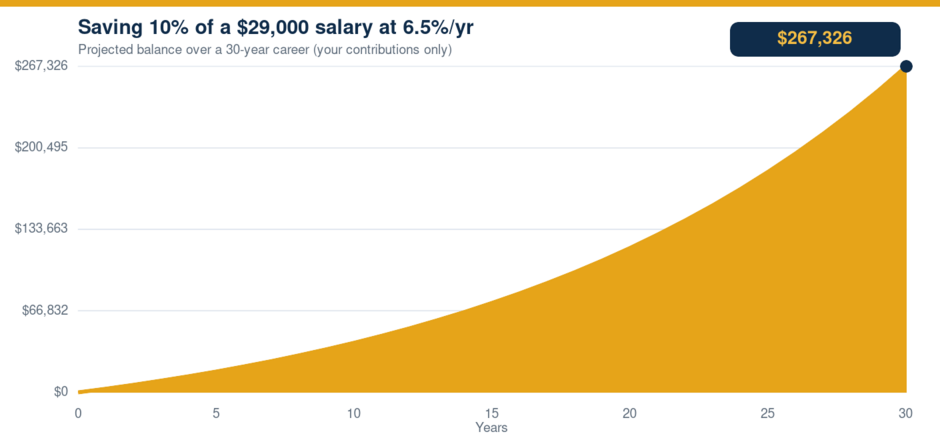
That's roughly $267,326 from steady saving alone. If that number surprises you, that's the power of compounding: small, consistent contributions turn into serious money when you give them decades to grow.
Common mistakes to avoid
- Thinking you earn too little to save. Even $20–$50 a paycheck, started early, becomes a meaningful sum. Waiting is the real mistake.
- Leaving a match on the table. If your employer offers any 401(k) match, that's free money — grab it first.
- Cashing out when you switch jobs. Roll old accounts over instead of cashing them out and losing money to taxes and penalties.
- Skipping the Saver's Credit. If you qualify and don't claim it, you're leaving a tax refund on the table.
Your game plan
- If your job offers a 401(k) match, contribute enough to get all of it.
- Open a Roth IRA and set up an automatic transfer every payday — even a small one.
- Claim the Saver's Credit at tax time (Form 8880) if your income qualifies.
- Raise your contribution a little whenever your pay goes up.
- Keep it in a low-cost, broadly diversified index fund and leave it alone.
None of this is financial advice — check the details for your own situation. But the message is simple and hopeful: a comfortable retirement isn't only for high earners. For cashiers, starting early, saving a little every payday, and letting time do the compounding is what gets you there.
Comments
No comments yet — be the first to share your thoughts.
Sign in or create an account to comment.