 Crypto & retirement
Crypto Estate Planning (2026): How to Pass Bitcoin to Your Heirs
Crypto’s biggest inheritance risk isn’t taxes. It’s lost access. With a bank account, your heirs can walk into a branch with a death certificate. With self-custodied Bitcoin, there’s no branch, no password reset and no customer-service line. If the keys are lost, the coins are gone for good. This guide covers how to build an access plan your family can actually follow, how inheritance works at exchanges and in crypto IRAs (most exchanges don’t let you name a beneficiary), the 2026 tax rules for heirs, and when a trust or multisig setup makes sense. Facts are as of November 2026.
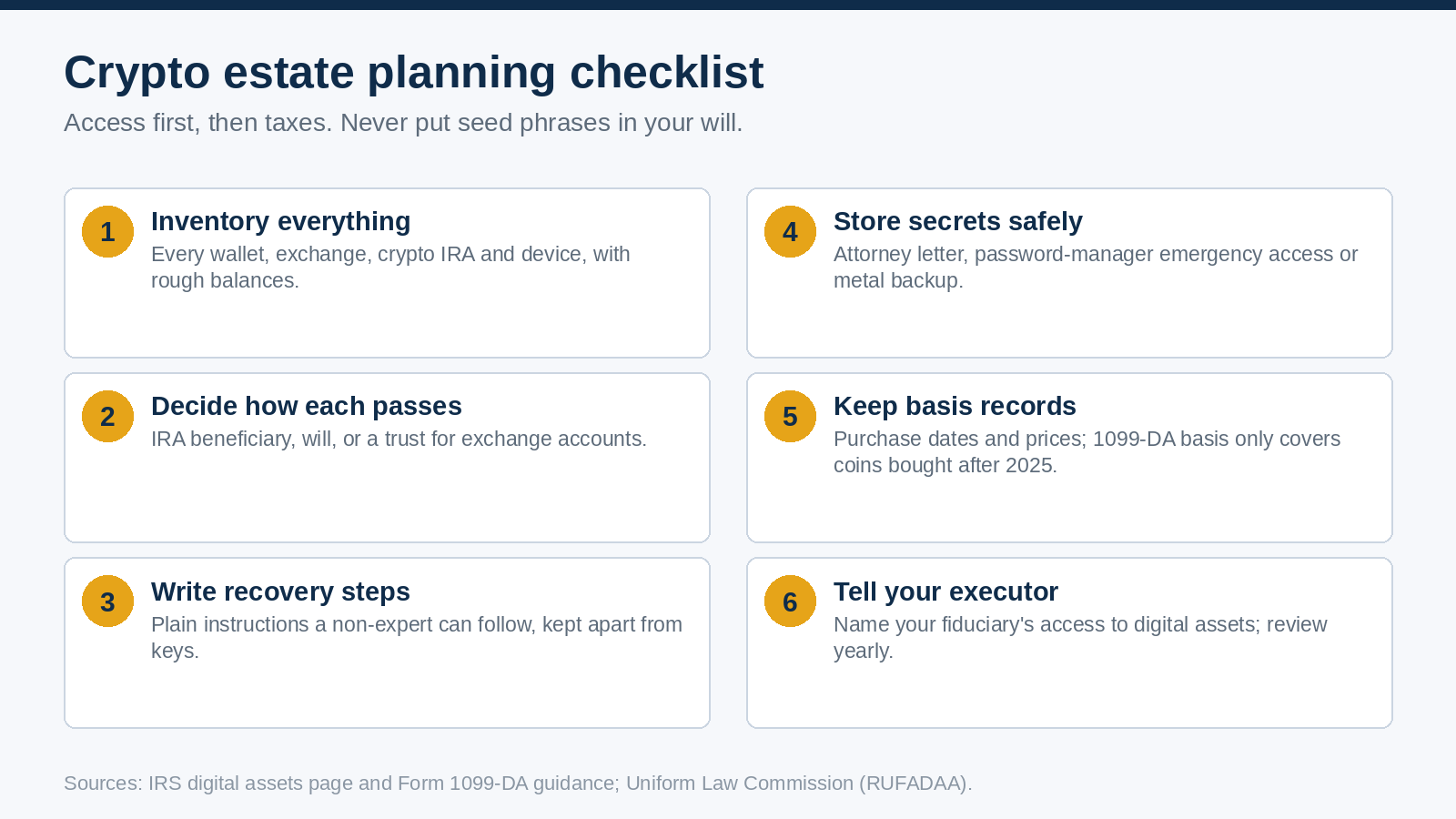
Crypto estate planning in five steps
- Make an inventory. List every wallet, exchange account, crypto IRA and hardware device, and roughly what each holds.
- Decide how each holding passes. Beneficiary designation (crypto IRAs, some brokerage accounts), your will, or a trust.
- Write recovery instructions a non-expert can follow, kept separate from the secrets themselves.
- Store the secrets safely so they can be found after you die but can’t be stolen while you’re alive.
- Tell your executor the plan exists, and review it once a year or whenever you move coins.

Step 1: Build a secure access plan
The goal is to make recovery possible for your heirs without exposing your secrets while you’re alive. A few guardrails:
- Never put seed phrases or private keys in your will. A will usually becomes a public court record once it goes through probate.
- Do document where things are: which wallets, which exchanges, which hardware devices, and the steps to open each. The will or a letter of instruction can point to this inventory without containing any keys.
- Store the secrets safely: for example, a sealed letter held by your attorney, a password manager with an emergency-access feature, or a metal seed backup in a safe deposit box. Avoid putting every piece in one place someone else can open alone.
- Write for a non-expert. Assume the person recovering it has never used a hardware wallet. Name the wallet software, the device, and what not to do (such as typing a seed phrase into a website).
- Test it. A plan nobody has walked through tends to fail at the worst time.
Step 2: Know how each type of account passes to heirs
Where you hold crypto decides how it transfers. This is where many families get surprised.
| Where the crypto is | Can you name a beneficiary? | How heirs get it |
|---|---|---|
| Self-custody wallet (hardware or software) | No | Whoever has the keys or seed phrase controls it. Your will or trust decides who should get it; your access plan decides whether anyone can. |
| Coinbase, Kraken or Gemini account | No, per each exchange’s help pages | The executor files a deceased-account claim with a death certificate and probate papers; assets pass under your will or state law. |
| Robinhood | Beneficiaries are available for brokerage and IRA accounts, but crypto isn’t included yet | Crypto passes as part of your estate. |
| Crypto IRA (for example, iTrustCapital) | Yes, primary and contingent beneficiaries | Beneficiaries inherit the IRA under the inherited-IRA rules, usually without probate. |
| Spot Bitcoin ETF in a brokerage account or IRA | Usually yes (transfer-on-death or IRA beneficiary) | Passes like any other fund held at that broker. |
Sources: Coinbase, Kraken, Gemini, Robinhood and iTrustCapital help pages. Policies change, so check your own platform.
Can I name a beneficiary on a crypto account?
Usually not at a regular crypto exchange. Coinbase, Kraken and Gemini all say they don’t currently offer beneficiary designations on individual accounts. Their deceased-account processes typically ask for an official death certificate, probate documents such as letters testamentary, the representative’s photo ID and a signed letter. That means exchange crypto usually goes through probate unless the account is owned by a trust. Retirement accounts are different: a crypto IRA, or a regular IRA holding a spot Bitcoin ETF, lets you name beneficiaries.
Holding crypto in a trust
A revocable living trust can own crypto, which can keep it out of probate and give a trustee clear authority. Exchange support varies: Kraken accepts trust accounts, including revocable trusts; Coinbase offers trust accounts only through its institutional platform; and Robinhood’s trust accounts don’t support crypto. Self-custodied coins can be assigned to a trust, but the trustee still needs the keys, so the access plan matters just as much.
Step 3: Understand the taxes your heirs will face
Step-up in basis for inherited crypto
The IRS treats digital assets as property (IRS: digital assets). Under the general rule for inherited property, an heir’s cost basis is the fair market value on the date of death (or the alternate valuation date, if the estate elects it) (IRS: gifts and inheritances FAQ). In practice, crypto that rose in value during your life can be sold soon after death with little or no capital gain. The IRS’s virtual-currency FAQ addresses gifts but not inheritance specifically, so the general rule is what applies.
Gifts are different. If you give crypto away while you’re alive, the recipient generally takes over your cost basis instead of getting a step-up, and if your basis isn’t documented it can be treated as zero (IRS virtual currency FAQs). That’s one reason highly appreciated coins are often held until death rather than gifted.
Keep cost-basis records
Brokers report gross proceeds of digital-asset sales on Form 1099-DA for sales on or after January 1, 2025, and cost basis for certain sales on or after January 1, 2026. Basis is only reported for coins bought after 2025 and kept at the same broker, so older or transferred coins can show no basis (IRS). Keep your own records of purchase dates and prices with your estate papers. Your executor will need them.
Federal estate and gift tax in 2026
For 2026, the federal estate and gift tax basic exclusion amount is $15,000,000 per person, indexed for inflation after that, and the annual gift exclusion is $19,000 per recipient (IRS Rev. Proc. 2025-32; IRS gift tax FAQ). Most estates owe no federal estate tax. Some states have their own estate or inheritance tax with much lower thresholds, which our best states to retire guide lists.
Crypto in an IRA: inherited-IRA rules apply
Crypto inside a Traditional or Roth IRA passes under the inherited-IRA rules, not the step-up rules. For most non-spouse beneficiaries of owners who died after 2019, the account must be emptied by the end of the 10th year after the death (IRS: retirement topics, beneficiary). If the owner had already started required minimum distributions, beneficiaries must also take annual withdrawals in years 1 through 9 under the final regulations that apply from 2025 (T.D. 10001). Traditional IRA withdrawals are taxable income to the heir. Inherited Roth IRA withdrawals are generally tax-free once the Roth has met the five-year rule. Our inherited IRA rules guide walks through every option.
Step 4: Consider more advanced tools for larger holdings
- Multisignature wallets need, for example, two of three keys to move funds. You can spread keys between yourself, a trusted person and a service, so no single lost or stolen key is fatal.
- Collaborative-custody inheritance services, such as Casa and Unchained, hold one key and help heirs recover funds after a waiting or verification period. Read the fees and terms closely. We don’t endorse any provider.
- A trust adds control (for example, staged payouts to young heirs) and privacy.
Each adds cost and complexity. Weigh them against the size of what you’re protecting.
Step 5: Give your executor legal authority
Most states have adopted the Revised Uniform Fiduciary Access to Digital Assets Act (RUFADAA), drafted by the Uniform Law Commission. It gives executors, trustees and agents a legal path to your digital assets and accounts. Instructions you give in a provider’s own online tool come first, then your will, trust or power of attorney, then the provider’s terms of service. So say plainly in your documents that your fiduciaries may access your digital assets.
How much crypto should be in a retirement plan anyway?
Estate planning is easier when crypto is a small, well-documented slice of your savings. Use the retirement savings calculator to check that your plan works without counting on crypto, and the how much do you need to retire calculator to see what your heirs’ inheritance might look like after your own needs are covered. Our guide on how much crypto to hold for retirement covers sizing.
The bottom line
Crypto estate planning is two jobs: make sure your heirs can access the assets, and make the transfer as tax-efficient as possible. Build a documented access plan that keeps secrets out of your will, use beneficiary designations where your accounts allow them, consider a trust for exchange holdings, and keep cost-basis records. Then have an estate attorney review it.
Common questions
Can I name a beneficiary on a crypto account?
Usually not at a regular exchange: Coinbase, Kraken and Gemini don’t currently offer it. Crypto IRAs, and IRAs or brokerage accounts holding spot Bitcoin ETFs, generally do.
Do heirs pay capital gains tax on inherited crypto?
Inherited property generally gets a basis equal to its value on the date of death, so heirs who sell soon after may owe little or no capital gains tax. Crypto inside an IRA follows inherited-IRA rules instead.
Should I put my seed phrase in my will?
No. A will usually becomes public during probate. Have the will point to where recovery instructions are kept instead.
Is crypto subject to estate tax?
Yes, at its value on the date of death. The 2026 federal exclusion is $15,000,000 per person, so most estates owe none, but some states have lower thresholds.
Can a trust hold cryptocurrency?
Yes. A revocable living trust can own crypto and may help avoid probate, but the trustee still needs the keys for self-custodied coins.
Sources
- IRS — Digital assets (property treatment, Form 1099-DA dates)
- IRS — Gifts and inheritances FAQ (basis of inherited property)
- IRS — Virtual currency FAQs (gifts of crypto)
- IRS — Rev. Proc. 2025-32 (2026 estate and gift amounts)
- IRS — Retirement topics: beneficiary
- IRS — T.D. 10001, final RMD regulations
- Uniform Law Commission — Fiduciary Access to Digital Assets Act, Revised
- Exchange help pages: Kraken, Coinbase, Robinhood
Educational information only, not financial, tax or legal advice. Crypto is volatile and speculative. Work with an estate attorney and a tax professional on your own plan.
Try it: Retirement Savings Projection
See what your savings could grow to by the age you want to retire. Everything runs in your browser, and nothing you type is sent anywhere.
Estimates only, based on the numbers you enter. Open the full Retirement Savings Projection or see all calculators.

Comments
No comments yet — be the first to share your thoughts.
Sign in or create an account to comment.