 Where to retire
Best States to Retire in 2026: Top 10 Ranked for Taxes & Costs
The best state to retire in is the one where your money goes furthest and you actually want to live. We ranked the top 10 US states to retire on four things that matter most to retirees: taxes (income tax, Social Security, retirement-account withdrawals, property and estate taxes), cost of living, climate and healthcare access. Below is the list, a tax table for each state with official sources, and the 2026 lists of states with no income tax and states that still tax Social Security. Tax facts are as of November 2026.
Where you retire can change your budget by thousands of dollars a year. The same nest egg funds a very different life in a low-tax, low-cost state than in an expensive one.
The top 10 states to retire, at a glance
| Rank | State | Why it ranks |
|---|---|---|
| 1 | Florida | No state income tax, no estate tax, warm year-round, unmatched retiree infrastructure |
| 2 | Tennessee | No income tax, low cost of living, mild four-season climate |
| 3 | Texas | No income tax, big-city healthcare, warm; property taxes run high |
| 4 | South Carolina | Coast and mountains, low cost; no Social Security tax plus large deductions at 65 |
| 5 | North Carolina | Mountains and coast, strong healthcare; no Social Security tax, low flat rate |
| 6 | Arizona | Warm, dry climate, big active-adult communities; 2.5% flat tax, no Social Security tax |
| 7 | Georgia | Low cost, mild weather and one of the biggest retirement-income exclusions |
| 8 | Nevada | No income tax, warm, more affordable housing than coastal states |
| 9 | Wyoming | No income tax and one of the lowest overall tax burdens in the country |
| 10 | Pennsylvania | The tax dark horse: no tax on Social Security or on retirement-plan withdrawals after retirement age |
Retirement taxes in the top 10 states (2026)
Here’s how each state on our list treats the three main kinds of retirement income. Rates are 2026 individual income tax rates from the Tax Foundation unless noted, with state-specific sources in the notes.
| State | 2026 income tax | Taxes Social Security? | IRA, 401(k) and pension withdrawals |
|---|---|---|---|
| Florida | None | No | Not taxed |
| Tennessee | None | No | Not taxed |
| Texas | None | No | Not taxed |
| South Carolina | Top rate 5.21% (cut in April 2026, retroactive to January 1) | No | Up to $10,000 retirement-income deduction at 65+, plus a $15,000 age-65 deduction |
| North Carolina | 3.99% flat | No | Generally taxed at the flat rate (some pre-1989 government pensions are exempt) |
| Arizona | 2.5% flat | No | Generally taxed at 2.5%; military retirement exempt |
| Georgia | 5.19% flat | No | Exclusion up to $35,000 per person at 62–64 and $65,000 at 65+ |
| Nevada | None | No | Not taxed |
| Wyoming | None | No | Not taxed |
| Pennsylvania | 3.07% flat | No | Eligible retirement-plan distributions after retirement age are not taxed |
Notes: South Carolina’s rate cut is summarized by EY Tax News (April 2026), and its deductions come from the SC Department of Revenue. Georgia’s exclusion is described by the Georgia Department of Revenue (dollar amounts per AARP’s Georgia tax guide). North Carolina’s pension exemption is the “Bailey” settlement explained by the NC Department of Revenue. Pennsylvania’s rule is in the PA Personal Income Tax Guide; an early IRA withdrawal is still taxable there. Arizona details are from AARP’s Arizona tax guide.
1. Florida: the retirement standard
Florida is #1 for good reason: no state income tax, so Social Security, pensions and IRA withdrawals aren’t taxed, and no estate or inheritance tax. It has warm weather all year and more retiree communities, doctors and services aimed at older adults than anywhere else. The trade-offs are summer heat, hurricane risk, and rising coastal housing and insurance costs. Look inland or along the Gulf for better value.
Property taxes are changing. Florida voters approved Amendment 3 on November 3, 2026 (unofficial results), which raises the homestead exemption on non-school taxes starting in 2027, with a smaller exemption for new residents during their first five years. Check the details with your county property appraiser before you buy.
2. Tennessee: low-tax value with mild seasons
Tennessee pairs no income tax with a low cost of living and a mild, four-season climate. The Tax Foundation ranks it third-lowest for overall state and local tax burden (7.6% of income, 2022 data). Cities like Knoxville and Chattanooga offer scenery and outdoor access at prices Florida increasingly can’t match.
3. Texas: no income tax and big-city options
With no state income tax and major metros (San Antonio, Austin, Houston, Dallas) full of top hospitals, Texas is a heavyweight. The catch is property tax, which runs among the highest in the country and helps fund the state in place of an income tax. Homeowners 65 and older get an extra school-district homestead exemption on top of the general one, per the Texas Comptroller.
4. South Carolina: coast and mountains, tax breaks at 65
South Carolina doesn’t tax Social Security. At 65 you can deduct up to $10,000 of retirement income, plus an age-65 deduction of up to $15,000 against other income (reduced by any retirement deduction you take), according to the SC Department of Revenue. Its top rate also dropped to 5.21% for 2026. Add a mild climate with beaches and Blue Ridge foothills, and Greenville, Charleston and the Grand Strand are popular, generally at lower cost than Florida.
5. North Carolina: geography and healthcare
From the Blue Ridge Mountains to the Outer Banks, North Carolina offers variety, a moderate cost of living and excellent healthcare around the Research Triangle. It doesn’t tax Social Security and has a flat 3.99% income tax for 2026. Most IRA and 401(k) withdrawals are taxed at that rate, so it’s less of a tax haven for big account balances than Florida or Tennessee.
6. Arizona: warm, dry and built for retirees
If you want warmth without Florida’s humidity, Arizona’s dry climate and huge active-adult communities are hard to beat. It doesn’t tax Social Security, and other retirement income faces a low 2.5% flat rate. Areas outside Phoenix and Scottsdale (Tucson, Prescott) offer real value.
7. Georgia: a tax-friendly sleeper
Georgia combines a low cost of living and mild weather with one of the country’s most generous retirement-income exclusions: up to $65,000 per person at 65 and older, and each spouse can claim it. Since the exclusion also covers interest, dividends and capital gains, many retirees owe little or no Georgia income tax. Social Security isn’t taxed.
8. Nevada: no income tax, more affordable than the coast
Nevada’s no income tax, warm climate and housing that’s typically cheaper than coastal California (Las Vegas, Reno, Henderson) make it a value play, with entertainment and amenities nearby. Summers are hot, but it’s a dry heat.
9. Wyoming: one of the lowest tax burdens
Wyoming has no income tax and the second-lowest state and local tax burden in the nation (7.5% of income) in the Tax Foundation’s rankings. It’s best for retirees who love wide-open spaces and don’t mind cold winters and longer drives to major hospitals.
10. Pennsylvania: the tax dark horse
Pennsylvania makes the list on taxes: it doesn’t tax Social Security or distributions from eligible retirement plans after retirement age, per the PA Department of Revenue. Add a moderate cost of living and a central Northeast location near family and major cities. One catch for estate planning: Pennsylvania has an inheritance tax on most heirs other than a spouse.
Best states to retire for taxes
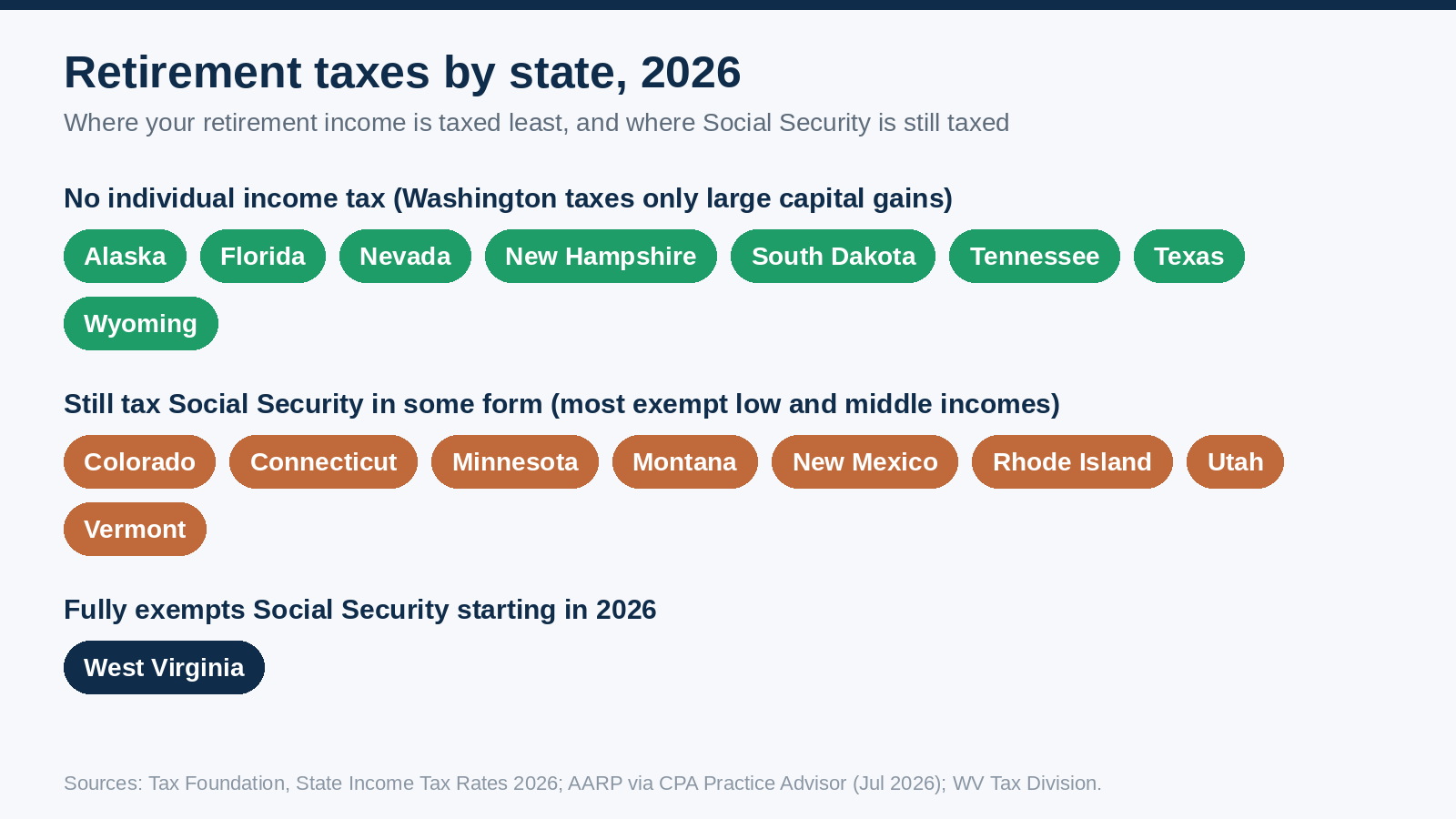
If taxes are your top priority, start with the states that don’t tax income at all. For 2026, the Tax Foundation lists eight states with no individual income tax: Alaska, Florida, Nevada, New Hampshire, South Dakota, Tennessee, Texas and Wyoming. New Hampshire repealed its interest and dividends tax as of 2025. Washington also has no tax on wages or retirement income, but it does tax large capital gains.
No income tax doesn’t always mean low taxes overall. States make up the money elsewhere, often through property or sales taxes. Texas is the classic example. That’s why total tax burden is worth a look. In the Tax Foundation’s latest state and local tax burden rankings (2022 data), the lowest burdens were Alaska (4.6%), Wyoming (7.5%), Tennessee (7.6%), South Dakota (8.4%) and Michigan (8.6%), against a US average of 11.2%.
States that tax Social Security in 2026
Most states don’t tax Social Security. For 2026, eight still do in some form: Colorado, Connecticut, Minnesota, Montana, New Mexico, Rhode Island, Utah and Vermont (per AARP data reported by CPA Practice Advisor). Most of them exempt lower- and middle-income retirees, so check the state’s own rules for your income. West Virginia fully exempts Social Security starting in 2026, finishing a three-year phase-out (WV Tax Division). Federal tax is separate: depending on your income, up to 85% of benefits can be federally taxable (SSA).
Estate and inheritance taxes
If leaving money to heirs matters to you, check the state’s death taxes too. As of 2026, 12 states and DC have an estate tax, some with exemptions as low as $1 million (Oregon), and five states have an inheritance tax: Kentucky, Maryland, Nebraska, New Jersey and Pennsylvania (Tax Foundation). None of the no-income-tax states on our list has either one.
How we ranked them (and how to pick yours)
- Taxes: income tax, plus how Social Security, pensions and withdrawals are treated, plus property and estate taxes.
- Cost of living: especially housing, the biggest lever on how far your savings go.
- Climate: warmth is popular, but mild four-season and dry climates rank high too.
- Healthcare access: being near good hospitals matters more each year.
No ranking fits everyone. The best state for you also depends on where your family lives, the climate you enjoy, and the specific town. Use this list to build a shortlist, then visit in the off-season and rent before you buy.
Run the numbers for your move
A lower-tax, lower-cost state can stretch your savings, but only your own numbers can show by how much. Plug your expected spending in the new state into the how much do you need to retire calculator, then check whether your savings get you there with the retirement savings calculator. To narrow your shortlist to a town, read our guide to the best cities and towns to retire. If you’re timing the move with your benefits, see when to claim Social Security.
The bottom line
Florida, Tennessee and Texas top the list thanks to zero income tax, low costs and warmth. But tax-smart picks like Georgia, South Carolina and Pennsylvania can leave as much money in your pocket for many retirees. Weigh taxes, cost, climate and healthcare against your own life, and confirm the current rules with the state’s revenue department before you move.
Common questions
What is the best state to retire in?
In our ranking, Florida is first, followed by Tennessee and Texas, mainly because none of them has a state income tax and all have large retiree communities. The best state for you also depends on cost of living, climate, healthcare and family.
Which states have no state income tax in 2026?
Alaska, Florida, Nevada, New Hampshire, South Dakota, Tennessee, Texas and Wyoming. Washington doesn’t tax wages or retirement income but does tax large capital gains.
Which states tax Social Security benefits in 2026?
Colorado, Connecticut, Minnesota, Montana, New Mexico, Rhode Island, Utah and Vermont, though most exempt lower- and middle-income retirees. West Virginia fully exempts benefits starting in 2026.
What are the best states to retire for taxes?
Start with the no-income-tax states such as Florida, Tennessee, Nevada and Wyoming. Georgia, South Carolina and Pennsylvania also tax retirement income lightly or not at all for many retirees. Check property, sales and estate taxes too.
Does Pennsylvania tax retirement income?
Not Social Security, and not distributions from eligible retirement plans after retirement age. Early IRA withdrawals are taxable, and Pennsylvania has an inheritance tax.
Sources
- Tax Foundation — State individual income tax rates, 2026
- Tax Foundation — State and local tax burden rankings (2022 data)
- Tax Foundation — Estate and inheritance taxes by state, 2026
- CPA Practice Advisor (AARP data) — the 8 states that tax Social Security
- West Virginia Tax Division — Social Security modification
- South Carolina Department of Revenue — tax tips for retirees
- EY Tax News — South Carolina lowers its income tax rate for 2026
- Georgia Department of Revenue — Retirement income exclusion
- North Carolina Department of Revenue — Bailey retirement benefits
- Pennsylvania Department of Revenue — Personal Income Tax Guide
- Texas Comptroller — Property tax exemptions
- Social Security Administration — Income taxes and your benefits
- AARP state tax guides: Arizona, Georgia
Educational information only, not financial or tax advice. State tax rules change often. Verify a state’s current treatment of retirement income, property and estate taxes with its revenue department before relying on it.
Try it: Retirement Savings Projection
See what your savings could grow to by the age you want to retire. Everything runs in your browser, and nothing you type is sent anywhere.
Estimates only, based on the numbers you enter. Open the full Retirement Savings Projection or see all calculators.

Comments
No comments yet — be the first to share your thoughts.
Sign in or create an account to comment.