 Retirement goals
How to Get to Early Retirement
Early retirement isn't luck or a huge salary — it's mostly your savings rate. This explains the simple math of financial independence, the 4% rule, how long it takes at different savings rates, and how to bridge the gap before traditional retirement accounts open.
The surprising truth about early retirement: it depends far less on how much you earn and far more on the gap between what you earn and what you spend. That gap — your savings rate — is the whole game.
The core idea: financial independence
You're financially independent when your investments can cover your spending indefinitely. A widely used rule of thumb — the 4% rule — says a portfolio can sustainably provide about 4% of its value per year. Flip that around and you get a target: you need roughly 25× your annual expenses invested.
Spend $40,000 a year? Your number is about $1 million. Trim spending to $30,000 and the target drops to $750,000 — which is why controlling expenses does double duty: it lowers the target and raises your savings rate.
Savings rate sets the timeline
Here's the part that makes early retirement possible for ordinary earners: the higher your savings rate, the shorter the road — dramatically so.
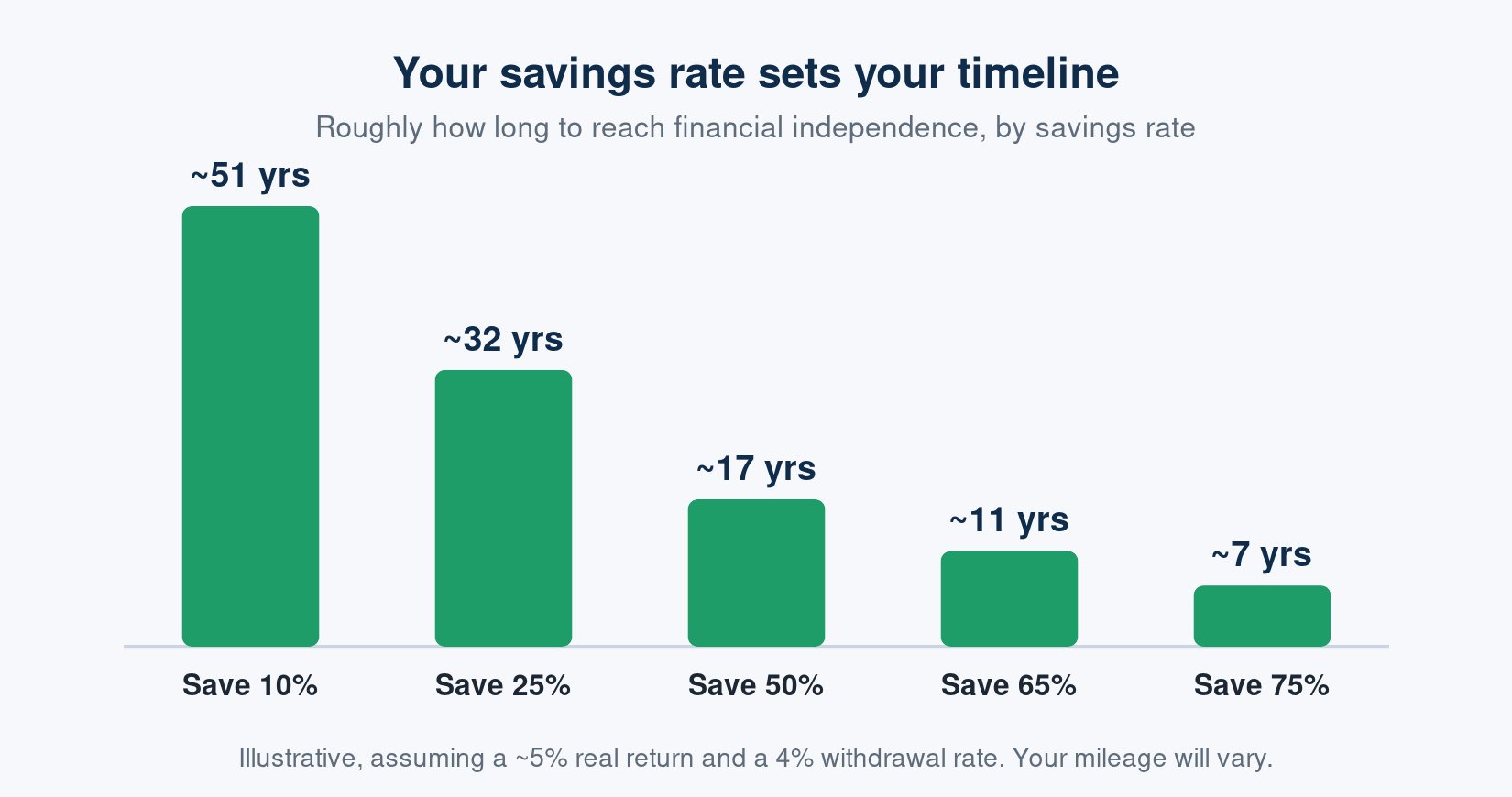
A 50% savings rate puts financial independence in reach in roughly 17 years, regardless of income. That's the engine behind the FIRE (Financial Independence, Retire Early) movement.
Bridging the gap to 59½
Retire at 45 and you can't touch most retirement accounts penalty-free until 59½. Early retirees bridge that gap with:
- Taxable brokerage accounts you can access any time.
- Roth contributions, which can be withdrawn tax- and penalty-free.
- A Roth conversion ladder or 72(t) withdrawals for accessing tax-deferred money early.
- The Rule of 55 for a 401(k) if you leave your job in or after the year you turn 55.
The realistic version
Full early retirement is one end of a spectrum. Many people use the same math to reach 'work optional' — enough saved that work becomes a choice, they can downshift, or take a lower-stress job. Even partial financial independence changes your life.
The lever is the savings rate. Raise it, protect it, and let the math do the rest.
Educational information only — not financial, tax, or legal advice. Figures are illustrative; verify against your own accounts and consult a qualified professional.

Comments
No comments yet — be the first to share your thoughts.
Sign in or create an account to comment.