Guides & articles

Roth vs. Traditional: Which Retirement Account Should You Choose?
Roth means tax-free later; Traditional means a tax break now. Here's the simple rule for choosing between a Roth and Traditional IRA or 401(k) — and why many people use both.
How to Use an HSA for Retirement (The Stealth IRA)
A Health Savings Account can be the most tax-efficient retirement account there is — triple tax-advantaged. Here's how to use an HSA as a stealth retirement fund.
When to Claim Social Security: Age 62 vs 67 vs 70
Claiming Social Security at 62, at full retirement age, or at 70 changes your monthly check for life. Here's how the trade-off works and how to decide.
Required Minimum Distributions (RMDs) Explained
What RMDs are, the age they start, how they're calculated, which accounts they apply to, and the steep penalty for missing one — in plain English, with IRS sources.
Retirement Planning for Lawyers & Attorneys
Retirement planning for lawyers: how to handle a high income, a late start with student debt, and the firm structures — associate, partner, solo — that decide which plans (401(k), cash-balance, solo 401(k)) fit.
Free Retirement Calculators & Tools: FINRA, SSA, Portfolio & Savings-Goal
A guide to the best free retirement calculators and tools — savings-goal, portfolio analyzer, compound interest, plus the official SSA and FINRA tools — and when to use each.
 Crypto & retirement
Crypto Estate Planning: Passing Bitcoin to Your Heirs
Crypto's biggest inheritance risk isn't taxes — it's lost access. This guide covers building a secure access plan, the trade-off between self-custody and custodial accounts, beneficiary designations, the step-up in basis, and how to make sure your heirs can actually recover what you leave them.
 Retirement goals
The Best Communities That Discuss Retirement
Some of the best retirement learning happens in communities of people going through the same decisions. Here are well-known forums and communities where retirement, investing, and financial independence are discussed — and how to use them wisely.
 Crypto & retirement
Crypto in a 401(k): Can You Hold Bitcoin at Work?
Most 401(k) plans don't offer crypto directly, but there are a few ways in — and some important warnings from regulators. This guide covers brokerage windows, direct Bitcoin options, the DOL's stance, why the employer match still comes first, and how an IRA can fill the gap.
 Where to retire
Best States to Retire: The Top 10, Ranked
Which states are best for retirement? We rank the top 10 US states for retirees — weighing taxes, cost of living, climate, and healthcare — with a clear reason for each. Florida, Tennessee, and Texas lead the list, but tax dark-horses like Pennsylvania earn a spot too.
 Retirement goals
What Retirement Looks Like for a Teacher
Teachers retire differently from most workers: many rely on a state pension plus a 403(b), and a 2025 law change restored full Social Security for many educators. Here's how the pieces fit together.
 Retirement goals
Is Social Security Raising the Retirement Age?
The Social Security 'full retirement age' has already risen from 65 to 67, and proposals to raise it further come up regularly. Here's what's actually changed, what's being proposed, and how to plan through the uncertainty.
 Retirement goals
How to Get to Early Retirement
Early retirement isn't luck or a huge salary — it's mostly your savings rate. This explains the simple math of financial independence, the 4% rule, how long it takes at different savings rates, and how to bridge the gap before traditional retirement accounts open.
 Retirement goals
What a 'Vanguard Retirement' Means
People often say they want a 'Vanguard retirement.' What they usually mean is a low-cost, index-fund, do-it-simply approach. Here's the philosophy behind it, how target-date funds work, and why fees quietly make or break a retirement.
 The basics
At What Age Can You Retire? Every Milestone, Explained
At what age can you retire? Legally there's no minimum — you can retire whenever you can afford it. But a series of specific ages unlock penalty-free access to your money and your benefits: 55, 59½, 62, 65, 67, 70, and 73. Here's each one explained, with the numbers and a claiming-age chart.
 Data & limits
How Much Do You Need to Retire? By Household, With Real Numbers
How much do you need to retire? It depends on your life. A single renter, a mortgage-free homeowner, a couple, and a family need very different amounts. Here's the simple formula, the bare-minimum floor, and specific nest-egg targets for each household type.
 Data & limits
2025 Retirement Contribution Limits: Every Account, Side by Side
The 2025 IRS contribution limits for every major retirement account — 401(k), 403(b), 457(b), IRA, SIMPLE, SEP, Solo 401(k) and the HSA — with catch-up amounts and the new SECURE 2.0 super catch-up, in one table.
 Data & limits
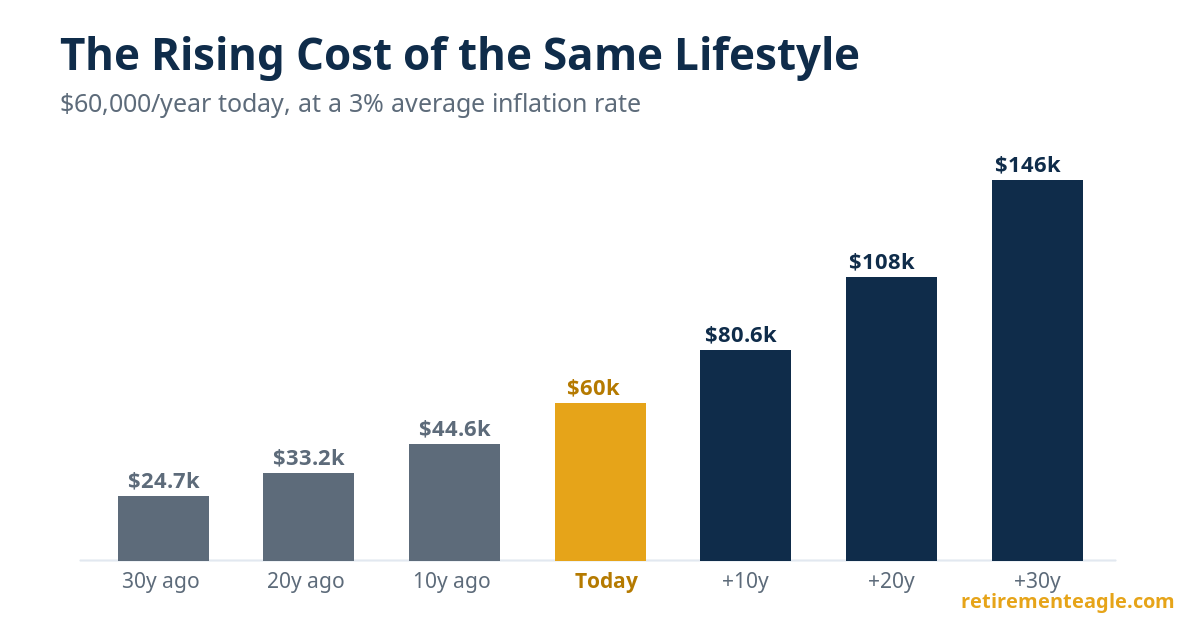
How Inflation Impacts Retirement (And How Much More You'll Need)
Inflation quietly raises the cost of the same retirement lifestyle every year. See how much more you'll need in the decades ahead versus the past — and how to protect your savings.
 Retirement goals
Social Security Retirement, Explained
Social Security is the backbone of most U.S. retirements. This explains how your benefit is calculated, how claiming age changes it, spousal and survivor benefits, and how to check your own numbers.
 Age guides
Retirement Planning in Your 70s and Beyond
In your 70s the focus shifts to required minimum distributions, healthcare costs, and passing on what's left efficiently and on your terms.
 Retirement goals
Retirement Planning: Where to Begin
If retirement planning feels overwhelming, the fix is an order of operations. This is a clear, step-by-step starting path that works whether you're 25 or 55, plus the benchmarks to measure progress.
 The basics
What Is Retirement? A Complete, Plain-English Guide
Retirement is the stage of life when you stop working for income and live on money you've built up — from Social Security, employer plans, and personal savings. A complete, plain-English guide to what retirement is, where the money comes from, how much you need, and when you can retire.
 Where to retire
The Best Places to Retire in the US: Cities and Towns
The best place to retire in the US depends on your budget, climate, and lifestyle, but a handful of cities and towns keep topping the lists. Here's a detailed guide to what makes a place great for retirement, the most tax-friendly states, and standout cities and towns for warmth, the outdoors, healthcare, and low cost.
 Data & limits
How Much Should You Have Saved for Retirement by Age?
Age-based retirement savings benchmarks as multiples of your salary: 1x by 30, 3x by 40, 6x by 50, and 10x by age 67 — with a chart, a dollar table, what they assume, and how to catch up if you're behind.
 Retirement goals
What Is the Best Retirement Age?
There's no single best retirement age, but there are clear, measurable trade-offs at each common age. This breaks down what changes for your Social Security, Medicare, savings, and taxes at 62, 65, 67, and 70.
 Early retirement
How to Retire Early: The Step-by-Step FIRE Playbook
Retiring early is possible, but it runs on math, not luck: reach financial independence by saving a large share of your income and investing the rest, until your portfolio covers your spending. Here's the step-by-step FIRE playbook — the number, the savings rate, and how to access your money before 59½.
 The basics
When Can I Retire? The Exact Ages, Rules, and Amounts
‘When can I retire?’ has two answers: when the rules let you, and when you can afford to. Here are the specific ages and laws — the Rule of 55, 59½ withdrawals, Social Security from 62 to 70, Medicare at 65, and RMDs at 73 — plus the dollar-amount test for whether you can actually afford it.
 By occupation
Which Retirement Plan Do You Get? A Guide by Occupation
Your job decides your retirement toolkit. A plain-English map of which plans each type of worker gets — private-sector 401(k), teacher pensions plus 403(b)/457(b), federal FERS and the TSP, nonprofit 403(b), and self-employed SEP or Solo 401(k).
 Age guides
Retirement Planning in Your 40s
Your 40s are the highest-leverage decade to secure retirement: check where you stand, max the right accounts, and balance college, debt, and saving. A practical, step-by-step plan.
 Age guides
Retirement Planning in Your 50s
In your 50s you get extra 'catch-up' contribution room and a clearer view of the finish line. Time to firm up the plan and reduce risk thoughtfully.
 Crypto & retirement
How Much Crypto Should Be in Your Retirement Portfolio?
There's no official number, but a disciplined framework beats guessing. This guide covers the 'only what you can afford to lose' rule, common 1–5% guardrails, how age changes the answer, rebalancing, and dollar-cost averaging into a position without trying to time the market.
 Retirement goals
Retirement Planning by Profession: 2026 Targets & Account Limits
How your profession changes your retirement math — 2026 IRS contribution limits, a computed nest-egg target for your income, pensions, and self-employed accounts.
 Crypto & retirement
Crypto Tax Strategies for Retirement
From the one-year holding rule to tax-loss harvesting (which crypto uniquely allows today) to donating appreciated coins and timing income in low-bracket years, these are practical, legal strategies to reduce the tax drag on crypto over a lifetime.
 Crypto & retirement
How Is Cryptocurrency Taxed? A Retirement Investor's Guide
The IRS treats crypto as property, so most transactions trigger capital gains or losses. This guide breaks down taxable events, short- vs long-term rates, staking and mining income, cost-basis methods, reporting forms, and the one move that makes all of it disappear: holding crypto in a retirement account.
 Crypto & retirement
Bitcoin ETFs in Your IRA or 401(k)
Spot Bitcoin ETFs let you add crypto to an IRA or 401(k) as easily as buying a stock — no wallets, no keys, no special custodian. Here's how they work, how they compare to owning coins directly, and how to buy one inside a retirement account.
 Crypto & retirement
Best Roth IRA for Crypto (2026): How to Choose
Comparing the two ways to hold crypto in a Roth IRA — a low-cost spot ETF vs. a self-directed crypto IRA — plus how to pick the best account for Bitcoin and other coins.
 Crypto & retirement
Can You Hold Crypto in an IRA?
You can hold Bitcoin and other crypto in an IRA, and it can be one of the most tax-efficient ways to own it. This guide covers both routes — a self-directed crypto IRA and a spot ETF in a normal IRA — plus fees, rules, and the mistakes that trigger taxes.
 By decade
Catching Up on Retirement in Your 40s (When You Didn't Plan)
Behind on retirement in your 40s? You're not out of time — with 20+ years left, an aggressive savings rate, catch-up contributions, and a few focused moves can still build a real nest egg. Here's a step-by-step catch-up plan for people who didn't get an early start.
 By decade
In Debt at 30? How to Balance Debt and Retirement Saving
In debt at 30 and torn between paying it off or saving for retirement? It's not all-or-nothing. Here's how to balance debt payoff and retirement saving, which debts to attack first, why the employer match always comes first, and why you shouldn't pause investing entirely in your 30s.
 Crypto & retirement
How to Buy a Bitcoin ETF in a Roth IRA
A step-by-step guide to holding a spot Bitcoin ETF (IBIT, FBTC, and more) inside a tax-free Roth IRA — which brokerages allow it, the contribution limits, and what to watch for.
 Retirement goals
What Retirement Plans Are — and How to Set and Achieve Them
'Retirement plan' means two things: the accounts (401(k), IRA, Roth, pension, HSA) and the actual plan for using them. This covers both — what each account does, and a repeatable system to set goals and hit them.
 Retirement goals
What Is a Retirement Age?
There isn't one retirement age — there are several, each unlocking something different: penalty-free withdrawals, Social Security, Medicare, and required withdrawals. Here's what each key age actually means.
 By occupation
TRS vs. 403(b) for Texas Teachers: How They Actually Work Together
For Texas teachers, TRS and a 403(b) aren't an either/or choice: TRS is your automatic pension, and a 403(b) or 457(b) is how you save on top. Here's how each works, why it matters that many Texas teachers don't get Social Security, and the 2025 WEP/GPO repeal.
 Age guides
Retirement Planning in Your 60s
Your 60s are about transition: when to claim Social Security, how Medicare works, and how to withdraw from savings without running out.
 By decade
How to Plan for Retirement in Your 30s
Two goals, one guide: how to plan for retirement in your 30s, and whether you could actually retire during your 30s. Here's the early-retirement (FIRE) math, the savings rates it takes, and a clear, step-by-step plan to build wealth automatically without sacrificing the life you're building now.
 Crypto & retirement
iTrustCapital Crypto IRA Review: Fees, Pros & Cons
iTrustCapital is a well-known crypto IRA provider, letting you hold cryptocurrency and physical gold or silver inside a tax-advantaged IRA. Its draw is a no-monthly-fee, per-trade pricing model and Roth tax-free growth. Here's an honest review — how it works, the fees, the pros and cons, and who it suits.
 Crypto & retirement
Crypto IRA Rules: Eligible Coins, Contribution Limits & Taxes
Crypto IRA rules confuse people because two systems overlap: normal IRA rules and how the IRS treats crypto as property. Short version — you fund it with cash up to the regular IRA limit, the provider decides which coins are eligible, and inside a Roth the growth is tax-free. Here are the rules in plain English.
 Crypto & retirement
Should You Hold Bitcoin in an IRA? Pros, Cons & How It Works
Should you hold bitcoin in an IRA? It's legal, and the tax advantages are real — a Roth crypto IRA means any bitcoin gains come out completely tax-free. But volatility, fees, and custody make it a small-slice decision, not a core holding. Here's the honest case for and against, and how to actually do it.
 Age guides
How to Save for Retirement in Your 20s: A Simple, Powerful Plan
Saving for retirement in your 20s is the highest-return money move you'll ever make, because you have the one thing income can't buy back: time for compounding. Here's a simple plan — how much to save, why a Roth IRA fits your 20s, and the order to do it in, even on a starter salary and with student loans.
 Crypto & retirement
Crypto Roth IRA: How to Hold Crypto in a Roth IRA Tax-Free (2026)
Yes, you can hold crypto in a Roth IRA — through a spot Bitcoin ETF or a self-directed IRA. Here are the tax advantages, contribution limits, and how to open one.