 The basics
At What Age Can You Retire? Every Milestone, Explained
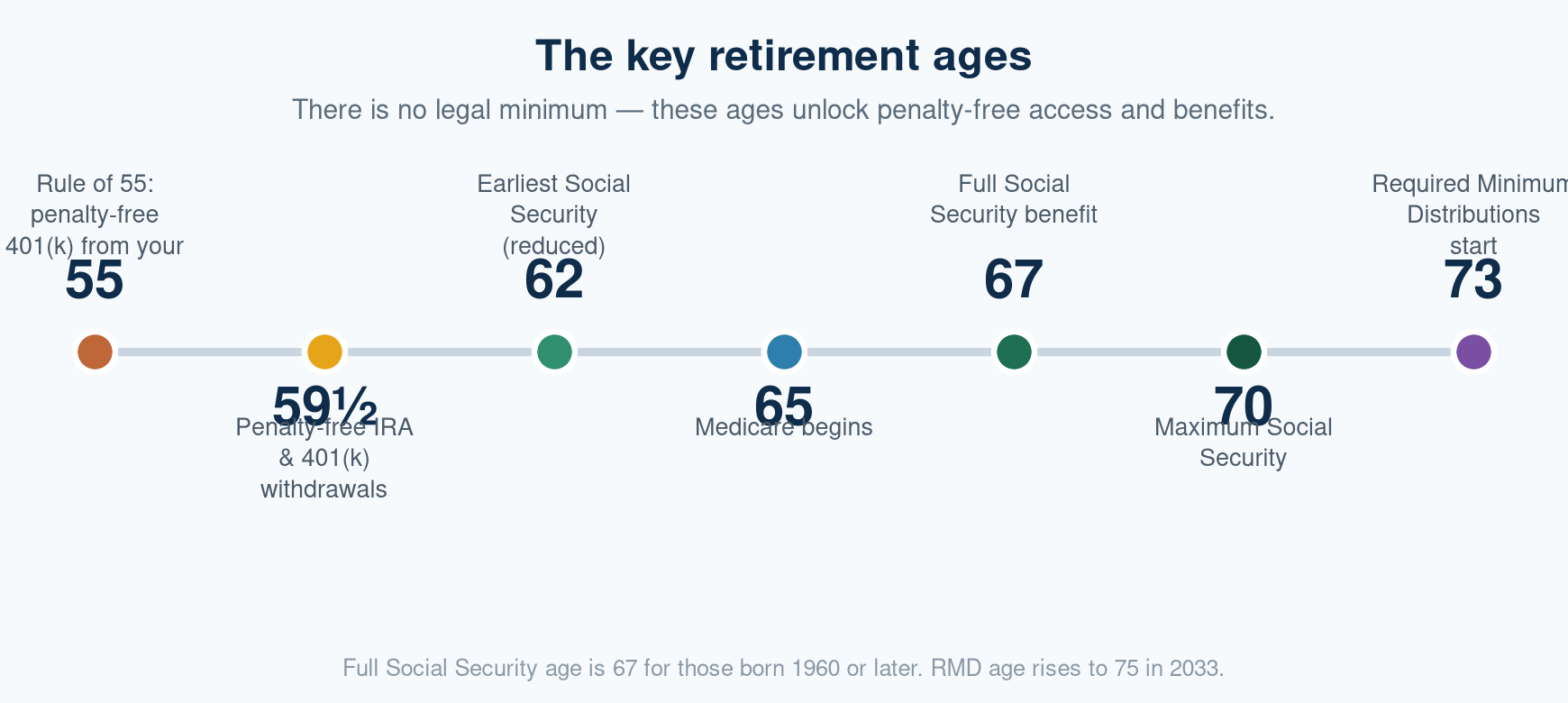
At what age can you retire? Legally there's no minimum — you can retire whenever you can afford it. But a series of specific ages unlock penalty-free access to your money and your benefits: 55, 59½, 62, 65, 67, 70, and 73. Here's each one explained, with the numbers and a claiming-age chart.
There is no legal minimum retirement age in the U.S. — you can stop working the day your savings can support you. What the ‘ages’ really control is when you can tap different money without penalty and when benefits begin. Here they are, on one timeline.
55 — the Rule of 55
If you leave your job in or after the year you turn 55, you can withdraw from that employer’s 401(k) or 403(b) with no 10% early-withdrawal penalty (you still owe income tax). It doesn’t apply to IRAs or old employers’ plans.
59½ — penalty-free retirement withdrawals
This is the universal milestone: at 59½ you can withdraw from IRAs and 401(k)s with no penalty. Before it, you generally owe a 10% penalty unless you use a special exception (Rule of 55, 72(t)/SEPP, Roth contributions, and others).
62 — earliest Social Security
You can first claim Social Security at 62, but the benefit is permanently reduced — roughly 25–30% below your full amount. If you’re still working, earnings above an annual limit can also temporarily withhold benefits until full retirement age.
65 — Medicare
Medicare eligibility begins at 65. Sign up during your enrollment window around your 65th birthday to avoid lifelong late penalties — this age matters even if you keep working.
66–67 — full retirement age
Your ‘full retirement age’ (FRA) is when you get 100% of your Social Security benefit. It depends on your birth year:
| Birth year | Full retirement age |
|---|---|
| 1954 or earlier | 66 |
| 1955 | 66 and 2 months |
| 1956 | 66 and 4 months |
| 1957 | 66 and 6 months |
| 1958 | 66 and 8 months |
| 1959 | 66 and 10 months |
| 1960 or later | 67 |
70 — maximum Social Security
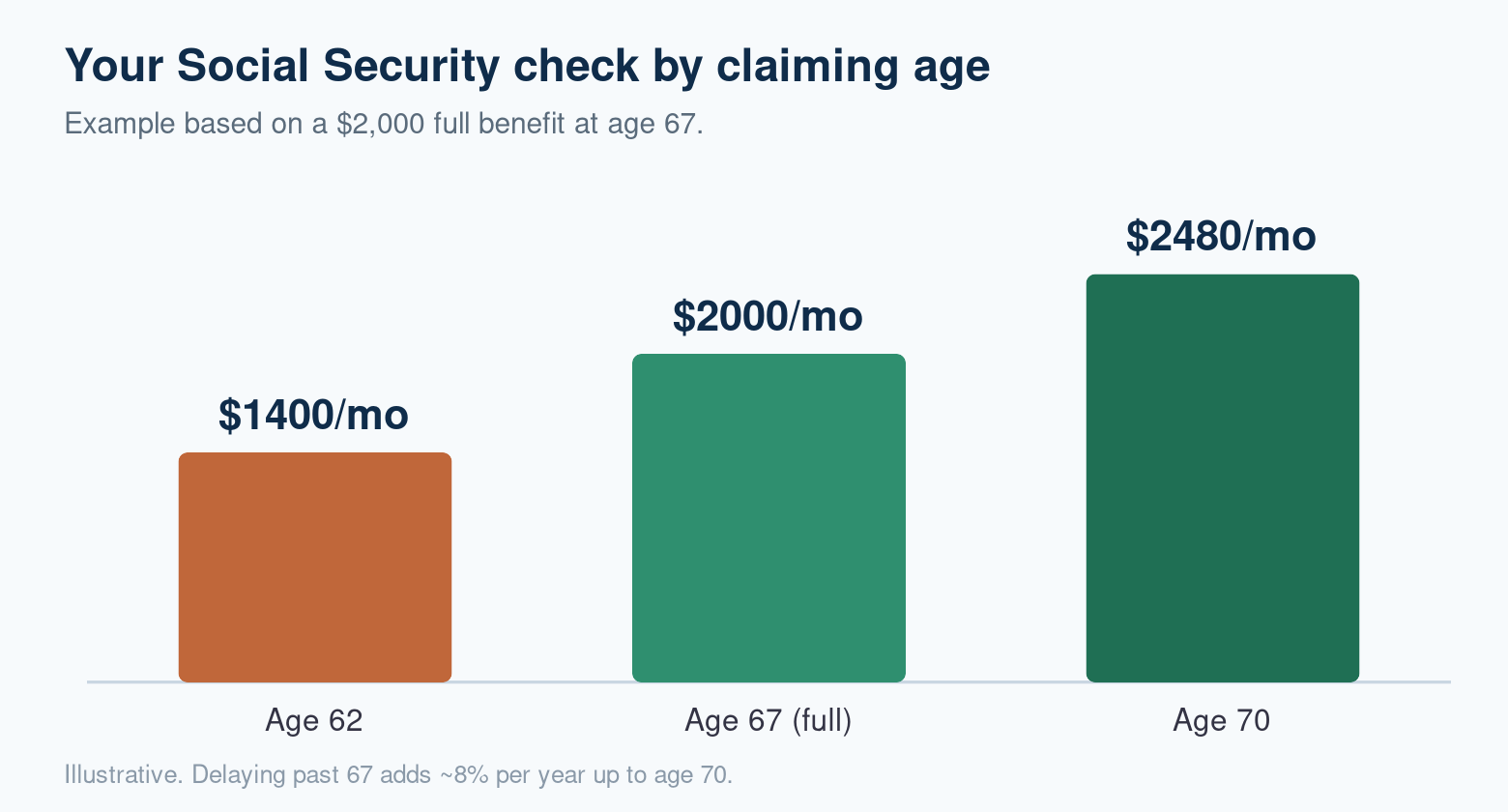
Every year you delay past full retirement age adds about 8% to your benefit, up to age 70. Waiting from 67 to 70 raises your check by roughly 24% — permanent, inflation-adjusted income. After 70 there’s no reason to wait. The chart shows the effect:
73 (rising to 75) — Required Minimum Distributions
At 73 you must start taking Required Minimum Distributions from pre-tax accounts (401(k)s, Traditional IRAs), whether you need the money or not. Under SECURE 2.0 the age rises to 75 in 2033. Roth IRAs have no RMDs during the owner’s lifetime.
So — what age can you retire?
As early as your money allows. A quick test: you’re roughly ready when your savings reach about 25 times the yearly spending your portfolio must cover (spending minus Social Security and any pension). Retire before 62, and you’ll bridge the gap with taxable savings, the Rule of 55, or a 72(t) plan until benefits and penalty-free withdrawals begin.
The bottom line
There’s no age that says ‘now you may retire’ — there’s the age your savings can support you, plus the milestones (55, 59½, 62, 65, 66–67, 70, 73) that decide when your money and benefits come online penalty-free. Know the dates, hit your number, and you choose the age.
Estimate your own earliest age with the Retirement Portfolio Analyzer.
Educational information only, not financial, tax, or legal advice. Ages and amounts reflect current U.S. rules and can change — confirm at SSA.gov and IRS.gov.

Comments
No comments yet — be the first to share your thoughts.
Sign in or create an account to comment.