 Data & limits
How Inflation Impacts Retirement (And How Much More You'll Need)
Inflation is the quietest, most underestimated risk in retirement. A market crash is obvious; a 3% annual rise in prices is invisible year to year — but over a 25- or 30-year retirement it can nearly triple the cost of the same lifestyle. If your income doesn't keep up, your standard of living slowly shrinks. This guide shows how big that effect really is, decade by decade, and what to do about it.
Why inflation hits retirees especially hard
- The time horizon is long. A 30-year retirement gives inflation three decades to compound against you.
- You no longer get raises. While working, wages often rise with (or above) inflation. In retirement, much of your income is more fixed — so rising prices bite harder.
- Some costs rise faster than average. Categories that matter most to retirees, like health care, have historically risen faster than the overall Consumer Price Index.
The same lifestyle, decade by decade
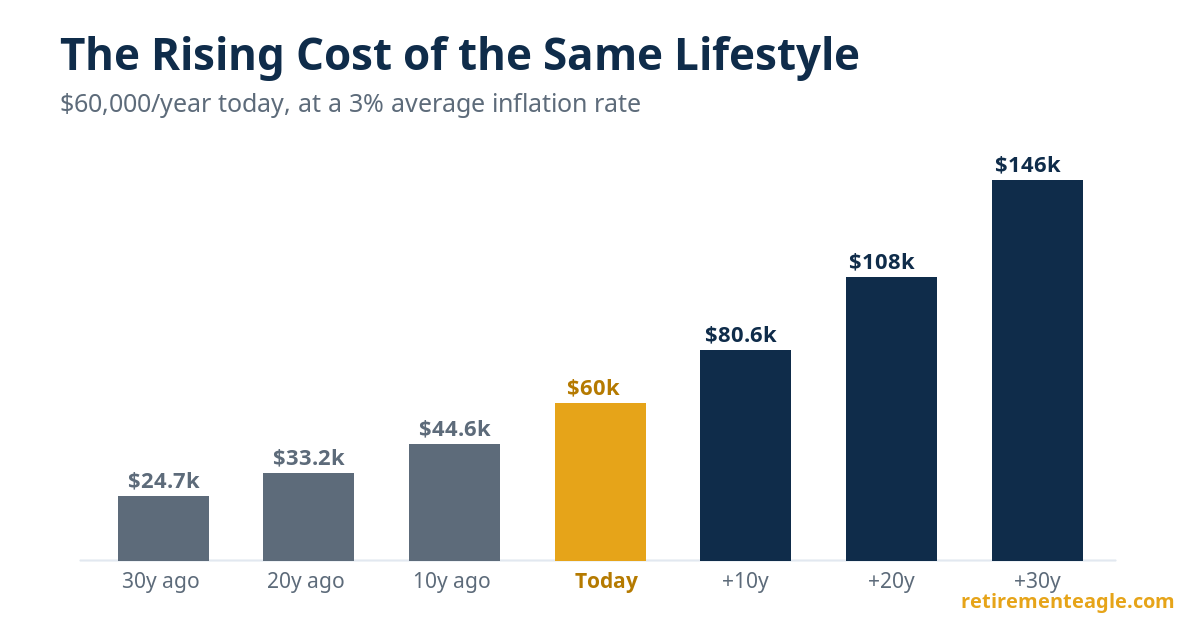
Here's the core idea. Suppose your lifestyle costs $60,000 a year today. The table below shows what that identical lifestyle costs at different points in time — computed at a 3% average inflation rate (roughly the long-run historical average; the Federal Reserve targets about 2%). These are illustrative figures from a steady rate, not actual year-by-year CPI, which varies:
| Point in time | Cost of today's $60,000 lifestyle | vs. today |
|---|---|---|
| 30 years ago | ~$24,700 | −59% |
| 20 years ago | ~$33,200 | −45% |
| 10 years ago | ~$44,600 | −26% |
| Today | $60,000 | — |
| In 10 years | ~$80,600 | +34% |
| In 20 years | ~$108,400 | +81% |
| In 30 years | ~$145,600 | +143% |
Read the bottom half slowly: to fund the same life you live on $60,000 today, you'd need roughly $108,400 a year two decades into retirement, and about $145,600 after thirty years — two and a half times as much money for zero improvement in lifestyle. That is the whole problem in one number.
Run it with your own spending and rate on the inflation calculator — change the amount, the years, and the inflation rate and watch the future cost move.
What it means for your retirement number
Because prices keep climbing after you retire, your nest egg has to keep growing too — it can't just sit in cash. A target built only on today's costs will fall short. Estimate a realistic number with the how much do you need to retire calculator, then pressure-test it against rising costs using the inflation calculator.
How to protect your retirement from inflation
- Keep some growth. Stocks have historically outpaced inflation over the long run, so even in retirement most plans keep a meaningful growth allocation rather than going all-cash.
- Use inflation-protected bonds. Treasury TIPS and I bonds adjust their value with inflation.
- Value Social Security's raise. Social Security includes an annual cost-of-living adjustment (COLA), one of the few inflation-linked income sources you'll have — a reason delaying your claim can be worth it (see when to claim Social Security).
- Plan for health-care inflation separately. An HSA used as a long-term account helps cover medical costs that rise faster than average.
Common questions
How much does inflation affect retirement?
Substantially. At 3% a year the cost of the same lifestyle roughly doubles about every 24 years, so your savings must keep growing throughout retirement, not just up to it.
What inflation rate should I plan with?
The Fed targets ~2%; long-run CPI has averaged ~3%. Planning around 2.5%–3% is common — try several on the inflation calculator.
Does Social Security keep up with inflation?
Partly — it has an annual cost-of-living adjustment, though the index used doesn't always match retirees' actual costs, especially health care.
Sources
- BLS — Consumer Price Index (historical inflation)
- SSA — Cost-of-living adjustment (COLA)
- U.S. Treasury — TIPS
Figures in the table are computed from a constant 3% rate for illustration, not actual year-by-year CPI.

Comments
No comments yet — be the first to share your thoughts.
Sign in or create an account to comment.