 The basics
What Is Retirement? A Complete, Plain-English Guide
Retirement is the stage of life when you stop working for income and live on money you've built up — from Social Security, employer plans, and personal savings. A complete, plain-English guide to what retirement is, where the money comes from, how much you need, and when you can retire.
Retirement is the stage of life when you stop working for a living and instead support yourself with money you’ve accumulated over the years. Your paycheck stops; income from savings, investments, and government or employer benefits takes its place. That’s the whole idea in one sentence — but the details are what make it work, so let’s go deep.
What retirement actually means
During your working years, your income comes from a job: you trade time and labor for a paycheck. Retirement flips that. Instead of earning money by working, you fund your life from three main places — Social Security, money from employer retirement plans, and your own savings and investments.
The transition is both financial and personal. Financially, you shift from saving a portion of your income to spending down what you saved. Personally, you gain back your time — which is why the happiest retirements are planned around purpose (family, hobbies, travel, volunteering, part-time work), not just money.
Retirement is a surprisingly modern idea
For most of history, people worked until they physically couldn’t, then relied on family. The idea of a funded, leisurely retirement is barely a century old. Germany created the first modern state pension in 1889, and the United States established Social Security in 1935, setting 65 as a benchmark retirement age.
Here’s the catch that shapes everything: in 1935, life expectancy was much lower, so people spent only a few years in retirement. Today, someone who retires at 65 may live 20, 30, or more years in retirement. A modern retirement has to fund decades — which is exactly why saving and investing early matters so much.
Where retirement income comes from
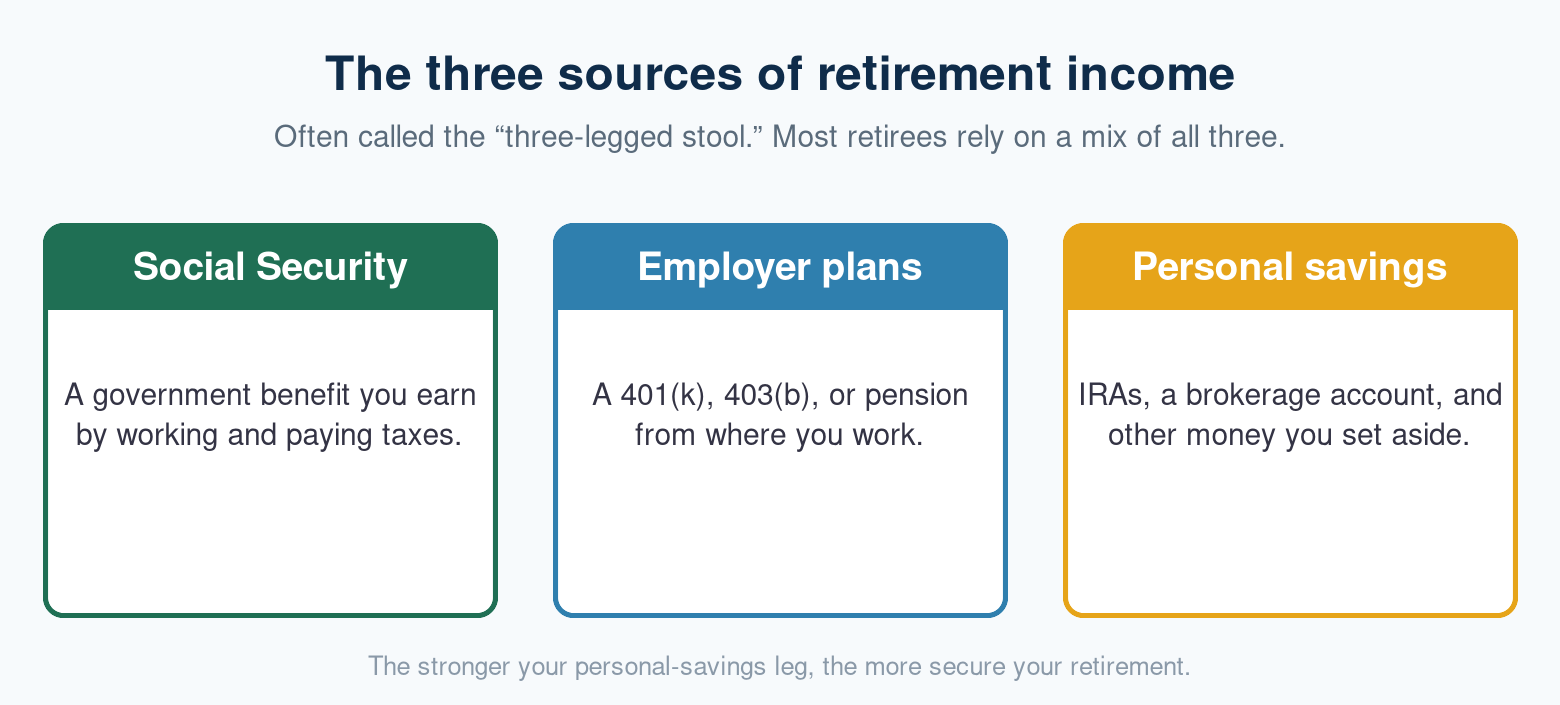
Financial planners describe retirement income as a “three-legged stool.” A stool is stable only if all three legs are solid; lean too hard on one and it wobbles.
Leg 1: Social Security
Social Security is a U.S. government program you pay into through payroll taxes while you work. In return, you earn a monthly benefit in retirement based on your lifetime earnings and the age you claim. It’s a genuine foundation — but only a foundation: for the average worker, Social Security replaces only about 40% of pre-retirement income, while most people need closer to 70–80% to maintain their lifestyle. It is meant to supplement your savings, not replace them.
Leg 2: Employer plans and pensions
There are two very different kinds of employer retirement plans:
- Defined-benefit plans (pensions): the employer promises a set monthly payment for life, usually based on your salary and years of service. Once common, traditional pensions are now mostly limited to government and union jobs.
- Defined-contribution plans (401(k), 403(b), 457(b), TSP): you (and often your employer, via a match) contribute money that you invest. Your future income depends on how much you save and how those investments grow. This is now the dominant model in the private sector.
If your employer offers a match, contributing enough to capture it is the single best deal in retirement saving — it’s an instant, guaranteed return on your money.
Leg 3: Personal savings
This is the money you set aside yourself, and it’s the leg you control most. It includes IRAs (Traditional and Roth), regular brokerage accounts, and cash savings. Tax-advantaged accounts like a Roth IRA let your money grow tax-free, which over decades can be worth a fortune. Because pensions have faded and Social Security is limited, personal savings has become the most important leg of the stool for most people.
Other sources round things out for many retirees: annuities (which convert savings into guaranteed lifetime income), part-time work, home equity, and Health Savings Accounts (HSAs) for medical costs.
How much money do you need to retire?
Two rules of thumb answer this quickly:
- The replacement-rate rule: aim to replace roughly 70–80% of your pre-retirement income each year. You typically need a bit less than your working income because you’re no longer saving for retirement or paying payroll taxes.
- The 25× rule (and the 4% rule): a common target nest egg is about 25 times your expected annual spending. The flip side is the 4% rule — the research-based guideline that you can withdraw about 4% of your savings in year one, adjust for inflation, and have a good chance of it lasting ~30 years.
So if you expect to spend $50,000 a year beyond Social Security, a rough target is about $1.25 million ($50,000 × 25). These are starting points, not guarantees — your real number depends on your spending, pensions, health, and how long you live.
When can you retire?
There’s no single “retirement age” — there are several important ages, each tied to a different rule:
- 59½: the age you can withdraw from 401(k)s and IRAs without a 10% early-withdrawal penalty.
- 62: the earliest you can claim Social Security — but at a permanently reduced benefit.
- 65: when Medicare (health coverage) begins.
- 66–67: “full retirement age” for Social Security (67 if you were born in 1960 or later), when you get your full benefit.
- 70: waiting until 70 to claim Social Security earns the largest possible monthly benefit.
You can also retire much earlier if you save aggressively — the FIRE movement (Financial Independence, Retire Early) shows it’s possible to retire in your 40s or even 30s by saving a large share of income and hitting that 25× number early.
The two phases of retirement
Every retirement has two financial phases, and they call for opposite strategies:
- Accumulation (your working years): you’re building the nest egg — contributing regularly, investing for growth, and letting compounding work. Time is your biggest advantage here.
- Decumulation (retirement itself): you’re turning savings into income — deciding how much to withdraw, in what order to tap accounts, and how to keep the money lasting. The goal shifts from growth to making it last.
The big risks to plan for
A good retirement plan isn’t just about reaching a number — it’s about protecting against what can go wrong over a multi-decade retirement:
- Longevity risk: outliving your money. The longer you live, the more you need — a good problem that still has to be funded.
- Inflation: rising prices quietly erode purchasing power. At 3% inflation, costs roughly double over 24 years, so your money must keep growing even in retirement.
- Sequence-of-returns risk: a market crash in your first few retirement years is far more damaging than the same crash later, because you’re withdrawing while prices are down.
- Healthcare and long-term care: often the largest and least predictable expense in retirement, and a major reason people underestimate what they’ll need.
Common myths about retirement
- “Social Security will be enough.” For almost no one — it replaces only about 40% of income.
- “I’ll spend way less in retirement.” Maybe on commuting and a mortgage — but healthcare, travel, and helping family often fill the gap.
- “It’s too early to think about this.” The opposite is true: money invested in your 20s and 30s does the heaviest lifting, thanks to compounding.
- “It’s too late for me.” Also false — catch-up contributions, a higher savings rate, and working a couple of extra years can dramatically improve a late start.
How to actually start
You don’t need to master everything today. Retirement saving comes down to a short, repeatable checklist:
- Capture your full employer 401(k) match — free money, first.
- Open and fund an IRA (a Roth IRA if you qualify) for tax-advantaged growth.
- Automate your contributions so saving happens without willpower, and raise the amount with every pay increase.
- Invest simply — a low-cost index fund or target-date fund gives instant diversification.
- Aim over time for a total savings rate around 15% of income, and check your progress once a year.
The bottom line
Retirement is simply the point where your money works instead of you — funded by Social Security, employer plans, and, most importantly, the savings you build yourself. Because a modern retirement can last decades, the two things that matter most are starting early and staying consistent. Every year you invest today buys you more freedom later.
Ready to see where you stand? Try the free Retirement Portfolio Analyzer or browse our retirement calculators.
Educational information only, not financial, tax, or legal advice. Figures reflect U.S. rules and can change — confirm current details at SSA.gov and IRS.gov, and consider talking to a qualified professional about your own situation.

Comments
No comments yet — be the first to share your thoughts.
Sign in or create an account to comment.