 Early retirement
How to Retire Early: The Step-by-Step FIRE Playbook
Retiring early is possible, but it runs on math, not luck: reach financial independence by saving a large share of your income and investing the rest, until your portfolio covers your spending. Here's the step-by-step FIRE playbook — the number, the savings rate, and how to access your money before 59½.
‘Early retirement’ means reaching financial independence — the point where your investments can cover your living costs — well before the traditional 60s. It’s the goal of the FIRE movement (Financial Independence, Retire Early), and it’s achievable, but it demands a very different intensity than ordinary retirement saving. Here’s exactly how it works.
Step 1: Find your FIRE number
Everything starts with one figure: your annual spending × 25. That’s the nest egg that, under the 4% rule, could sustain your lifestyle indefinitely. Spend $40,000 a year? Your target is about $1,000,000. Because early retirements last longer, many use a safer 3–3.5% withdrawal rate (roughly 28–33× spending) to be conservative.
This is why frugality is a superpower for early retirement: cutting your spending lowers the finish line and raises how much you can save.
Step 2: Maximize your savings rate — the master lever
How soon you retire depends far more on the percentage of income you save than on how much you earn. The chart shows the rough relationship:
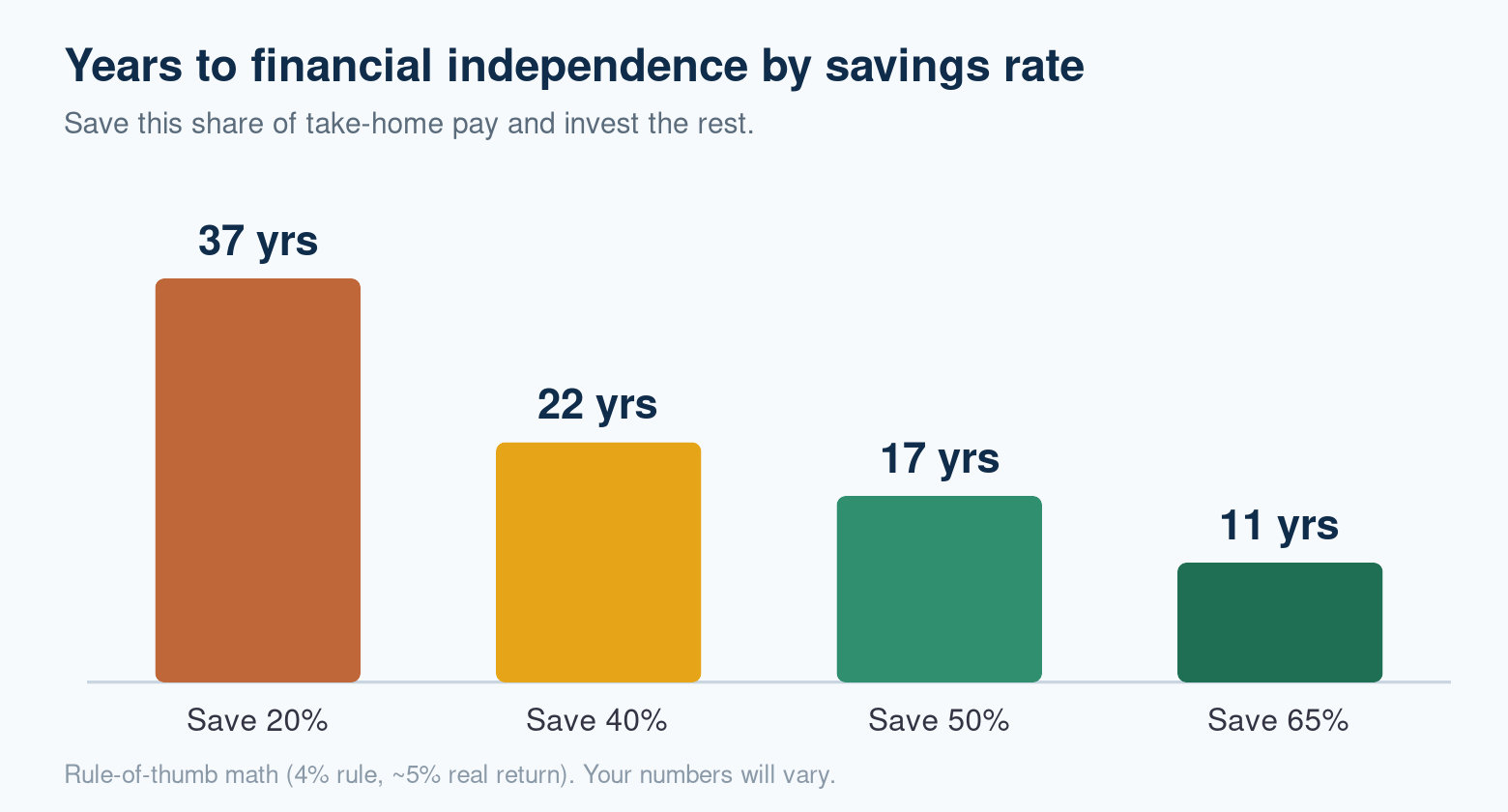
Save 20% and independence is decades away; save 50% and it’s in the teens; save 65% and it’s around a decade. To get there, work both sides of the equation: raise income (career growth, side income) and cut the big three — housing, transportation, and food — which dominate most budgets.
Step 3: Invest the gap simply and tax-efficiently
- Fill tax-advantaged accounts first: capture the 401(k) match, then max the 401(k), IRA, and HSA. These supercharge growth by cutting taxes.
- Keep it simple: low-cost, broad index funds beat stock-picking over long horizons and won’t derail your plan.
- Build a taxable ‘bridge.’ A regular brokerage account has no age restrictions — it’s the money you live on before 59½.
Step 4: How to access money before 59½
The biggest early-retirement puzzle is reaching your money without the 10% penalty. You have several legal tools:
- Taxable brokerage: no age rules — the simplest bridge.
- Roth contributions: withdraw what you contributed (not earnings) anytime, tax- and penalty-free.
- Roth conversion ladder: convert Traditional funds to Roth, wait 5 years, then withdraw the converted amount penalty-free — a staple of early retirees.
- 72(t) / SEPP: take substantially equal periodic payments from an IRA to avoid the penalty.
- Rule of 55: if you leave your job at 55+, tap that employer’s 401(k) penalty-free.
Step 5: Solve healthcare before you quit
Employer coverage disappears when you retire, and Medicare doesn’t start until 65. Early retirees typically buy coverage on the ACA marketplace, where subsidies are based on income — and a retiree living off savings often has low taxable income, which can mean a surprisingly affordable plan. Budget for it either way; it’s the most-underestimated early-retirement cost.
Step 6: Protect against a bad start (sequence risk)
A market crash in your first few retired years is the single biggest threat, because you’re withdrawing while prices are down. Defenses: keep a 1–2 year cash buffer, stay flexible enough to cut spending in down years, and consider a lower initial withdrawal rate. These turn a fragile plan into a durable one.
Choose your flavor of FIRE
- Lean FIRE: retire on a modest budget with a smaller nest egg — freedom sooner, less cushion.
- Fat FIRE: a bigger nest egg for a comfortable lifestyle — takes longer or a higher income.
- Coast FIRE: save hard early, then stop adding and let compounding carry you to a normal-age retirement.
- Barista FIRE: semi-retire — light work (often for health benefits) covers part of your costs.
Common early-retirement mistakes
- Underestimating healthcare and taxes in retirement.
- Forgetting the pre-59½ access problem until it’s too late.
- Using a 4% rate over a 50-year horizon without a cushion.
- Chasing risky bets to get there faster — which can set you back years.
The bottom line
Retiring early isn’t magic — it’s a high savings rate, simple investing, a smart withdrawal plan, and solutions for healthcare and pre-59½ access. Nail your number, push your savings rate as high as you comfortably can, and build the bridge. Do that, and an early retirement moves from fantasy to a dated plan.
See how your savings rate changes your timeline with the Retirement Portfolio Analyzer.
Educational information only, not financial, tax, or legal advice. FIRE math uses simplifying assumptions; confirm details for your situation.

Comments
No comments yet — be the first to share your thoughts.
Sign in or create an account to comment.