 Age guides
Retirement Planning in Your 50s: 2026 Catch-Up Limits & a 10-Year Checklist
Your 50s are the decade when retirement stops being an idea and becomes a date. You likely earn more than you ever have, the IRS lets you save more once you turn 50, and the big decisions (when to stop working, when to claim Social Security, how to pay for health care before 65) are close enough to plan in detail. This guide gives you the 2026 numbers and a checklist for the decade.
Step 1: Find out where you stand
Start with two numbers: what you'll need, and what you're on track to have.
- Your target. Estimate the yearly income you'll want in retirement and the nest egg that supports it with our how much do you need to retire calculator.
- Your pace. Enter your current balances and monthly savings in the retirement savings calculator to see where you'll land at 62, 65 or 67.
- Your Social Security estimate. Get it from your my Social Security account. It's based on your actual earnings record, so it's far better than a guess.
If the gap looks big, don't panic. The 50s come with the most powerful catch-up tools of your working life.
Step 2: Use the catch-up limits
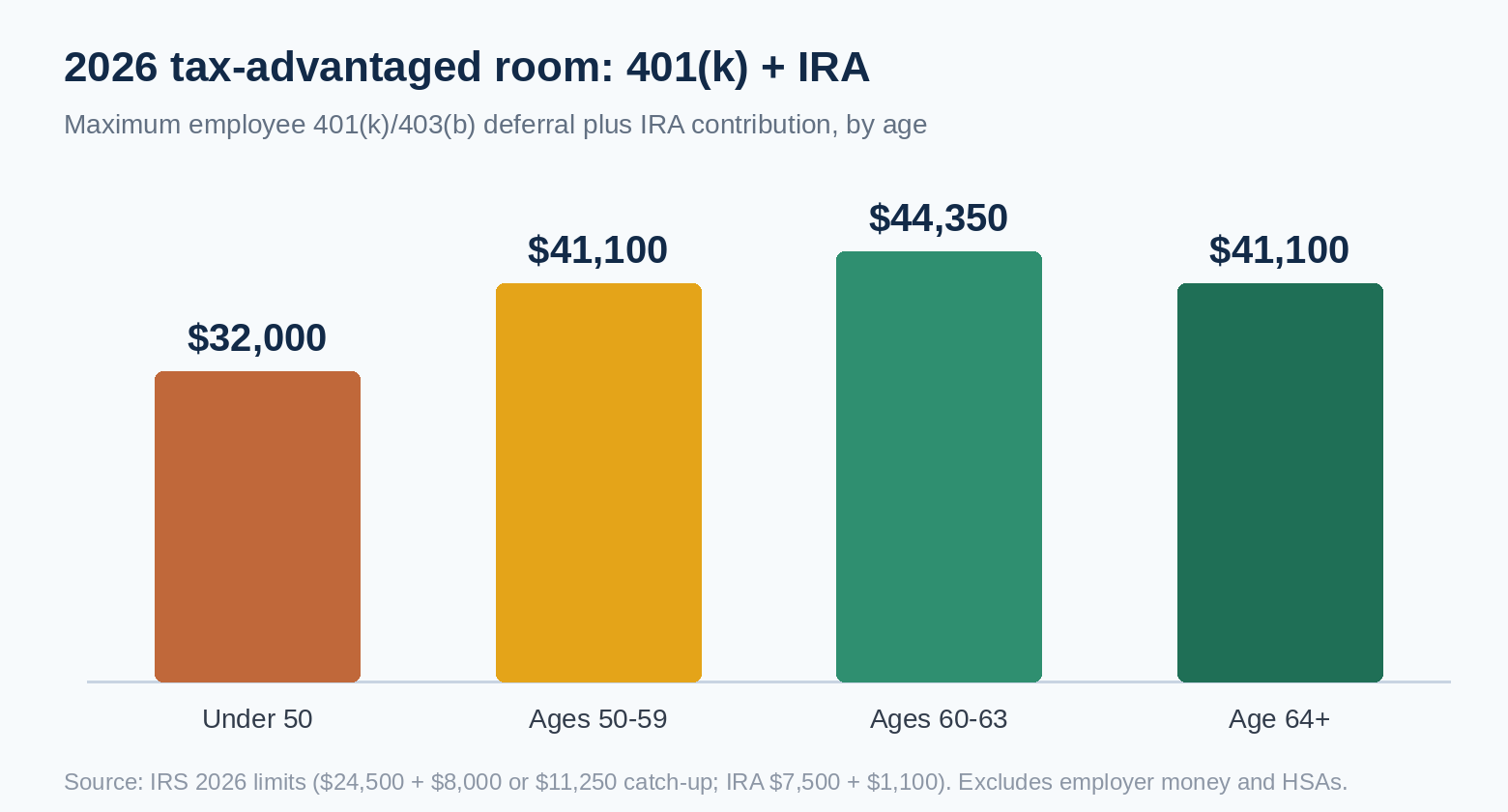
Once you turn 50, the IRS lets you add catch-up contributions on top of the normal limits. For 2026 (IRS 2026 limits):
| Account | Under 50 | Age 50–59 | Age 60–63 |
|---|---|---|---|
| 401(k), 403(b), governmental 457(b), TSP | $24,500 | $32,500 | $35,750 |
| IRA (traditional or Roth) | $7,500 | $8,600 | $8,600 |
| SIMPLE IRA | $17,000 | $21,000 | $22,250 |
A few details that matter:
- The 60–63 "super catch-up" raises the workplace-plan catch-up to $11,250 in the years you turn 60, 61, 62 and 63. At 64 it drops back to $8,000.
- Higher earners' catch-ups go in as Roth. If your FICA wages from your employer were over $150,000 in 2025, your 2026 catch-up contributions to that employer's plan must be Roth (after-tax) (IRS Notice 2025-67).
- HSAs get a catch-up at 55. If you have an HSA-eligible health plan, you can add $1,000 a year on top of the 2026 limits of $4,400 (self-only) or $8,750 (family) (IRS Publication 969). See our HSA for retirement guide.
Every limit is explained in our 2026 contribution limits guide.
Step 3: Pick a realistic retirement age
Your target age changes everything else. Retiring at 60 instead of 67 means seven fewer years of saving and seven more years of spending. Try both dates in the savings goal calculator and see how the monthly savings needed changes. Our guide to the ages that unlock each benefit lays out the milestones.
Step 4: Know the Rule of 55
Normally, taking money from a retirement plan before 59½ costs an extra 10% tax. But if you leave your job in or after the calendar year you turn 55, withdrawals from that employer's 401(k) or 403(b) avoid the 10% extra tax. The age is 50 for certain public safety workers in government plans. The rule does not apply to IRAs (IRS exceptions).
If you might retire between 55 and 59½, think twice before rolling your last employer's 401(k) into an IRA. The rollover can cost you this exception. Our early retirement guide covers other ways to bridge the gap.
Step 5: Plan health insurance before 65
Medicare starts at 65 for most people. If you retire earlier, you'll need coverage on your own until then, and it's often the biggest cost of retiring early. Price it before you pick a date. When 65 gets close, our guide on when to sign up for Medicare explains the windows and penalties.
Step 6: Start your Social Security strategy
You can claim as early as 62, but your benefit is permanently reduced. For anyone born in 1960 or later, full retirement age is 67, and claiming at 62 cuts the benefit by about 30% (SSA). Waiting past full retirement age adds delayed retirement credits until 70. You don't need to decide now, but your 50s are the time to learn the trade-offs. Read when to claim Social Security, and if you're married, plan the two claims together.
Step 7: Adjust risk on purpose
As retirement gets closer, a big market drop has less time to recover before you need the money. That doesn't mean moving everything to cash; your savings may need to last 30 years. It means choosing a mix you can stick with through a bad year, and keeping the next few years of planned withdrawals in steadier assets. Check your current mix and fees with our retirement portfolio analyzer.
Step 8: Clear the decks
- High-interest debt should be gone before you retire. A credit card payment on a fixed income is a drag every month.
- Your mortgage is a judgment call. Paying it off lowers the income you need in retirement; keeping it leaves more money invested. Either way, know your payoff date.
- An emergency fund still matters, and it matters more if you might retire early. See emergency fund vs. retirement savings.
- Beneficiaries and documents. Check the beneficiaries on every account, and get a will, powers of attorney and health care directives in place.
Your 50s checklist
- Get your target and your pace from the calculators above.
- Raise contributions to use catch-up room, especially at 60–63.
- Pick a target retirement age and test one earlier and one later.
- If you might leave work between 55 and 59½, plan around the Rule of 55.
- Price health insurance for any years before 65.
- Download your Social Security statement and learn your claiming options.
- Review your investment mix, fees and beneficiaries once a year.
Next decade: see retirement planning in your 60s.
Common questions
How much can I contribute to my 401(k) in my 50s?
In 2026, $32,500 at ages 50 to 59 ($24,500 plus an $8,000 catch-up), and $35,750 in the years you turn 60 through 63.
Is it too late to save for retirement at 50?
No. You may have 15 or more working years left, and catch-up contributions let you save more than younger workers. Delaying retirement or Social Security by even a few years can also make a big difference.
Can I retire at 55 and use my 401(k)?
Yes, if you leave your job in or after the year you turn 55. Withdrawals from that employer's 401(k) avoid the 10% early-withdrawal tax, though they're still taxed as income. The rule doesn't apply to IRAs.
What is the 60 to 63 catch-up?
A higher workplace-plan catch-up for the years you turn 60, 61, 62 and 63. For 2026 it's $11,250 instead of $8,000.
When should I start planning for Social Security?
In your 50s. Download your statement, learn how claiming at 62, 67 or 70 changes your benefit, and coordinate with your spouse if you're married.
Sources
- IRS — 2026 retirement plan and IRA limits
- IRS Notice 2025-67 (2026 limits, Roth catch-up wage threshold)
- IRS Publication 969 (HSA limits and catch-up)
- IRS — Exceptions to tax on early distributions (Rule of 55)
- SSA — Benefit reduction for early retirement

Comments
No comments yet — be the first to share your thoughts.
Sign in or create an account to comment.