 Age guides
Retirement Planning in Your 60s: Social Security, Medicare & Withdrawals
Your 60s are when the plan turns into paychecks. In this one decade you may stop working, claim Social Security, enroll in Medicare and start drawing down your savings. Each choice has deadlines and some can't be undone. The Federal Reserve's 2025 household survey found that only 53% of non-retirees aged 60 and older thought their retirement savings were on track (Federal Reserve). If you're in the other half, the decisions below matter even more.
The ages that matter
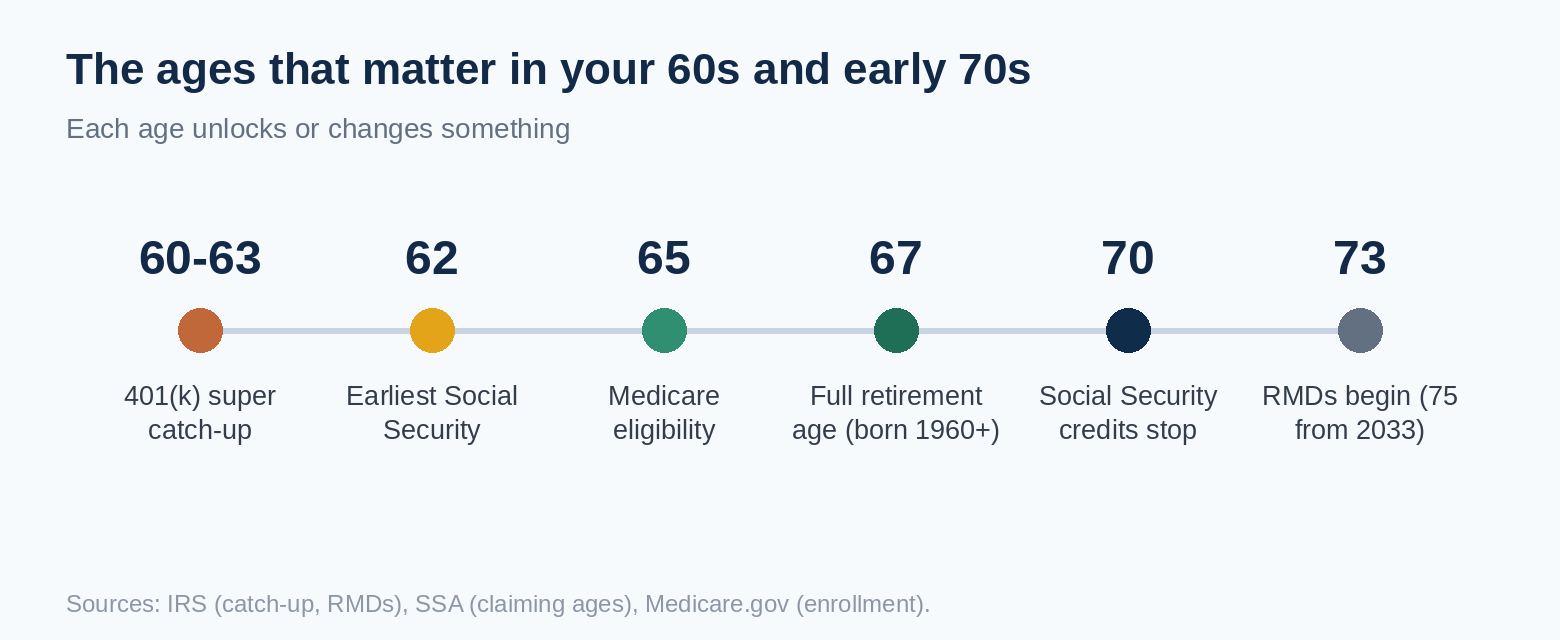
| Age | What happens |
|---|---|
| 60–63 | Higher 401(k)/403(b) catch-up: $11,250 instead of $8,000 in 2026 (IRS) |
| 62 | Earliest age to claim Social Security, with a permanent reduction (SSA) |
| 65 | Medicare eligibility; your 7-month enrollment window surrounds your birthday |
| 67 | Full retirement age for anyone born in 1960 or later |
| 70 | Delayed retirement credits stop, so there's no gain in waiting longer to claim (SSA) |
| 73 | Required minimum distributions begin for people reaching that age now; the age rises to 75 in 2033 (IRS RMD FAQs) |
Decision 1: When to stop working
Each extra working year does three things at once: it adds a year of savings, removes a year of withdrawals, and can raise your Social Security. Test a few dates (say 62, 65 and 67) in the how much do you need to retire calculator and the retirement savings calculator. Phased retirement, part-time work or consulting can also bridge the gap between your last full-time job and your first Social Security check.
Decision 2: When to claim Social Security
If your full retirement age is 67, claiming at 62 cuts your benefit by about 30% for life. Waiting past 67 adds delayed retirement credits of 8% a year until 70 (SSA). For married couples, the higher earner's choice also sets the survivor benefit the surviving spouse keeps. Our guide to when to claim Social Security covers the trade-off in detail.
Working while claiming early? If you claim before full retirement age and keep working, Social Security withholds part of your benefit once your earnings pass a yearly limit. The money isn't lost: your benefit is recalculated upward at full retirement age (SSA: Receiving benefits while working).
Decision 3: Medicare at 65
Unless you're covered by a current employer's plan at a company with 20 or more employees, sign up during your Initial Enrollment Period. Missing it can mean a Part B penalty of 10% for each full year you went without it, usually for life. In 2026 the standard Part B premium is $202.90 a month (CMS). Read when to sign up for Medicare before you turn 64½.
Decision 4: How to take money out
Most retirees draw from three kinds of money: taxable accounts, tax-deferred accounts (traditional 401(k)s and IRAs) and tax-free accounts (Roth). The order matters for your taxes:
- Use the low-tax years. The years between retiring and starting Social Security and RMDs often have unusually low taxable income. That can be a good time to withdraw from traditional accounts or convert some money to Roth at a low tax rate.
- Watch the knock-on effects. Extra taxable income can make more of your Social Security taxable, up to 85% of benefits (IRS Publication 915), and it can raise your Medicare premiums two years later. In 2026 the surcharge starts above $109,000 of income for single filers and $218,000 for joint filers (CMS).
- Get ready for RMDs. Shrinking traditional balances before 73 can make your required withdrawals smaller later. See our RMD guide and Roth vs. traditional guide.
A tax professional can map out a withdrawal order for your exact accounts. It's one of the most valuable things to pay for in your 60s.
Decision 5: Your pension, if you have one
If you have a pension, you may have to choose between a lump sum and monthly payments, and between a single-life payment and a joint-and-survivor payment that keeps paying your spouse. These choices are usually permanent. Monthly payments act like an extra Social Security check; a lump sum gives you control but also the job of making it last. If your private-sector pension plan fails, the Pension Benefit Guaranty Corporation insures benefits up to legal limits; see the PBGC entry in our directory.
Decision 6: Protect against the bad years
- Keep a cash reserve so you don't have to sell investments after a market drop. See emergency fund vs. retirement savings.
- Plan for inflation. Prices that rise for 25 or 30 years add up. Social Security has cost-of-living increases; most private pensions and savings don't. Our guide to how inflation impacts retirement shows the effect.
- Think about long-term care: how you'd pay for help at home or in a facility, and who would manage your money if you couldn't. Put powers of attorney and health care directives in place now.
Your 60s checklist
- Use the 60–63 super catch-up while you're still working.
- Test retirement at several ages before you give notice.
- Choose a Social Security claiming age, together with your spouse if married.
- Put your Medicare enrollment window on the calendar.
- Build a withdrawal plan that uses your low-tax years and accounts for RMDs.
- Make pension elections carefully; most can't be changed.
- Update beneficiaries, your will and your powers of attorney.
Still in your 50s? Start with retirement planning in your 50s.
Common questions
Is 60 too late to start saving for retirement?
No. The 60 to 63 super catch-up lets you put up to $35,750 into a 401(k) in 2026, and working a few extra years or delaying Social Security can make a large difference.
What is the best age to retire in your 60s?
There's no single best age. Many people aim for 65 to line up with Medicare, or 67, their full Social Security retirement age. Test several dates with a calculator before you decide.
Should I take Social Security at 62 or wait?
If you're healthy and can cover your expenses from work or savings, waiting usually means a larger lifetime benefit and a bigger survivor benefit for a spouse. Claiming at 62 can make sense if you need the income or have health concerns.
What should I do at 65?
Sign up for Medicare during your 7-month enrollment window unless you have coverage through current work at a large employer, and stop HSA contributions in time.
When do required minimum distributions start?
At 73 for people reaching that age now, rising to 75 in 2033. Roth IRAs have no RMDs during the owner's lifetime.
Sources
- Federal Reserve — Economic Well-Being of U.S. Households in 2025
- IRS — 2026 retirement plan and IRA limits
- SSA — Benefit reduction for early retirement
- SSA — Delayed retirement credits
- SSA — Receiving benefits while working
- CMS — 2026 Medicare Parts A & B premiums and deductibles
- IRS Publication 915 (taxation of Social Security benefits)
- IRS — RMD FAQs
Try it: Retirement Savings Projection
See what your savings could grow to by the age you want to retire. Everything runs in your browser, and nothing you type is sent anywhere.
Estimates only, based on the numbers you enter. Open the full Retirement Savings Projection or see all calculators.

Comments
No comments yet — be the first to share your thoughts.
Sign in or create an account to comment.