 The basics
When to Sign Up for Medicare: Deadlines, Penalties & Working Past 65
Most people should sign up for Medicare during the 7-month window around their 65th birthday. The big exception is if you, or your spouse, are still working and covered by a large employer's health plan. Getting the timing wrong can mean a gap in coverage and a late penalty that, for Part B, usually lasts for life. Because Social Security's full retirement age is now 67 for anyone born in 1960 or later, many people reach 65 without claiming Social Security, and they have to sign up for Medicare themselves.
Will you be enrolled automatically?
Only if you're already getting Social Security (or Railroad Retirement) benefits. Medicare.gov says you get Part A and Part B automatically at 65 "as long as you start getting Social Security benefits at least 4 months before you turn 65." Everyone else has to sign up through Social Security, most easily online at ssa.gov with a my Social Security account (Medicare.gov: How do I sign up?).
Your Initial Enrollment Period
Your Initial Enrollment Period lasts 7 months: the 3 months before the month you turn 65, your birthday month, and the 3 months after. Coverage always starts on the first of a month. Premium-free Part A starts the month you turn 65. For Part B, signing up before your birthday month means coverage starts the month you turn 65; signing up in your birthday month or later means it starts the month after you sign up (Medicare.gov: When does coverage start?).
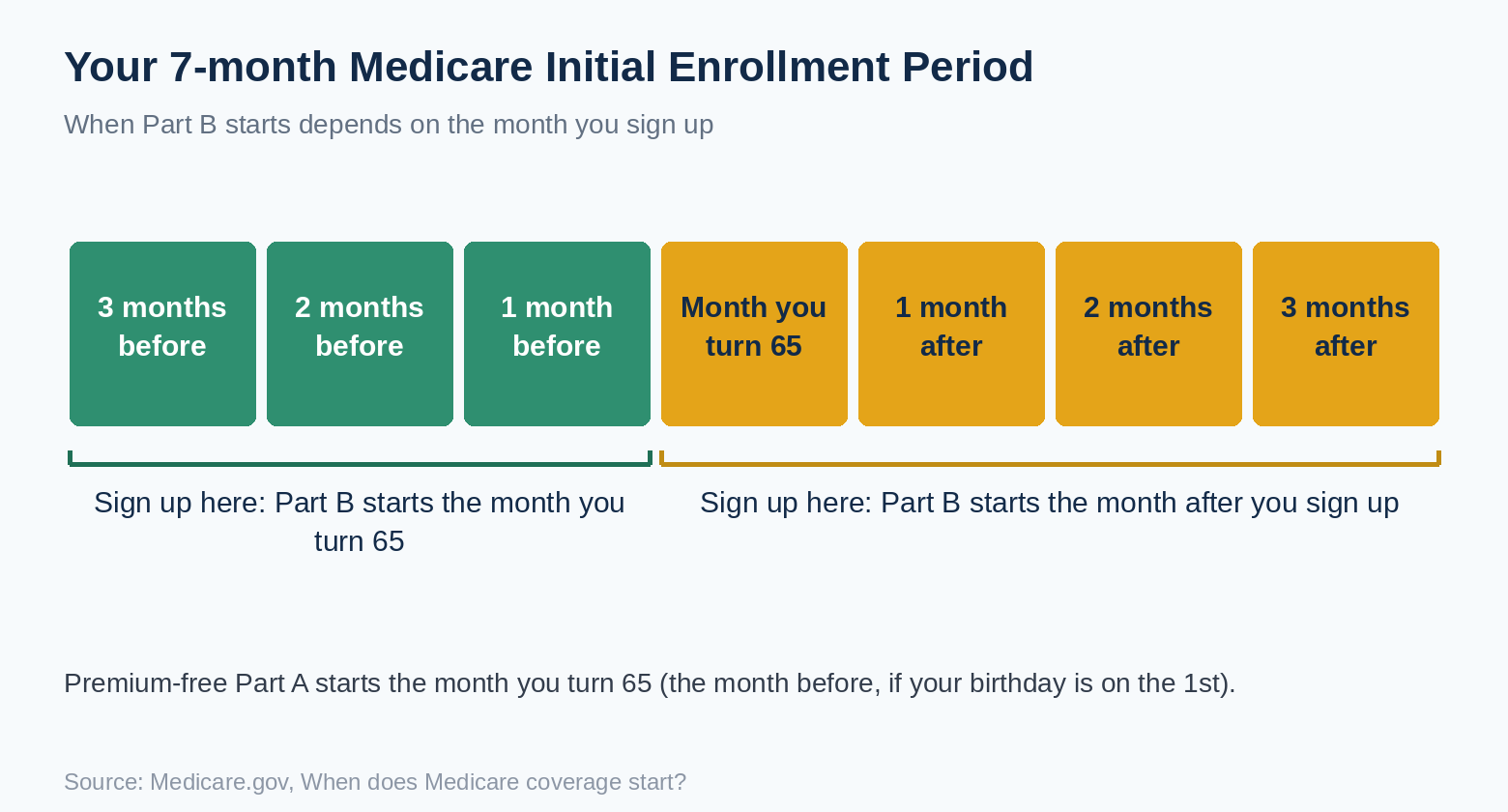
The simple rule: if you aren't covered by a current employer's plan, sign up in the first three months of the window so there's no gap.
Still working at 65?
Whether you can wait depends mostly on the size of the employer providing your health coverage (yours or your spouse's):
- Employer with 20 or more employees: you can usually delay Part B while you're covered through current work. Many people still take premium-free Part A at 65. When the job or the coverage ends, you get a Special Enrollment Period of 8 months to sign up for Part B without a penalty.
- Employer with fewer than 20 employees: Medicare.gov warns that the job's coverage might not pay for services unless you have both Part A and Part B. In that case, sign up during your Initial Enrollment Period.
The 8-month window starts when the job or the coverage ends, whichever is first, "even if you choose COBRA or other coverage that's not Medicare" (Medicare.gov: When can I sign up?). COBRA and retiree coverage don't count as coverage from current work, so don't use them as a reason to wait. Before you delay, ask your employer's benefits office in writing how its plan works with Medicare.
Late penalties
- Part B: an extra 10% for each full year you could have had Part B but didn't. For most people it lasts as long as they have Part B, which usually means for life.
- Part D (drug coverage): an extra 1% for each month without a drug plan or other creditable drug coverage once you were first eligible, if the gap is 63 days or more. It's added for as long as you have Medicare drug coverage.
- Part A: most people don't pay a premium for Part A, so there's no penalty. If you must buy Part A, a late signup can raise its premium by 10% for twice the number of years you delayed.
Source: Medicare.gov: Avoid late enrollment penalties. If you missed your windows and don't qualify for a Special Enrollment Period, the General Enrollment Period runs January 1 to March 31 each year, with coverage starting the month after you sign up.
If you have an HSA
You can't contribute to a Health Savings Account once you're enrolled in Medicare (IRS Publication 969). There's a second trap: when you sign up after 65, premium-free Part A can be backdated up to 6 months, but not before the month you turned 65. HSA contributions made during those backdated months count as excess contributions. Medicare's guidance is to stop HSA contributions at least 6 months before you apply (Medicare: Enrolling in Part A & Part B). Money already in your HSA can still pay for qualified medical costs, including Medicare premiums. See our HSA for retirement guide.
What Medicare costs in 2026
| Item | 2026 amount |
|---|---|
| Part B standard monthly premium | $202.90 |
| Part B annual deductible | $283 |
| Part A hospital deductible (per benefit period) | $1,736 |
| Part A premium | $0 for about 99% of people; up to $565 a month for those without enough work history |
Source: CMS 2026 Medicare premiums and deductibles fact sheet.
Higher incomes pay more. If your modified adjusted gross income is above $109,000 (single) or $218,000 (married filing jointly), you pay an income-related monthly adjustment amount (IRMAA) on top of the standard Part B premium, starting at $284.10 a month in total for 2026 (CMS). It's based on your tax return from two years earlier, so a large Roth conversion or IRA withdrawal at 63 can raise your Medicare premiums at 65. Plan big withdrawals with that in mind; our RMD guide and Roth vs. traditional guide cover the tax side.
Retiring before 65
Medicare doesn't start until 65 for most people, so retiring at 60 or 62 means paying for health insurance on your own for several years. That cost often decides whether an early retirement works. Add it to your budget in the how much do you need to retire calculator, and test the effect of extra years of spending with the retirement savings calculator. Our guide to when to claim Social Security covers the other big decision in these years.
Your Medicare checklist
- About 4 months before you turn 65, decide whether you'll be covered by a current employer's plan.
- If not, sign up in the first 3 months of your Initial Enrollment Period.
- If yes, confirm the employer's size and how its plan works with Medicare, in writing.
- Stop HSA contributions in time.
- Decide how you'll handle drug coverage so you don't trigger the Part D penalty.
- Look at your income two years ahead to avoid an unplanned IRMAA surcharge.
Common questions
Do I have to sign up for Medicare at 65 if I'm still working?
Not always. If you have health coverage through current work at an employer with 20 or more employees, you can usually delay Part B and sign up within 8 months after the job or coverage ends. At smaller employers, you generally need to enroll at 65.
Am I automatically enrolled in Medicare at 65?
Only if you've been getting Social Security or Railroad Retirement benefits for at least 4 months before you turn 65. Otherwise you need to sign up through Social Security.
What is the Medicare Part B late penalty?
An extra 10% on your Part B premium for each full year you could have had Part B but didn't. For most people it lasts as long as they have Part B.
Does COBRA count as employer coverage for Medicare?
No. COBRA doesn't count as coverage based on current work, and your 8-month window to sign up for Part B starts when your job or coverage ends, even if you choose COBRA.
When should I stop contributing to my HSA before Medicare?
At least 6 months before you apply for Medicare (or Social Security) after 65, because premium-free Part A can be backdated up to 6 months. You can't contribute to an HSA once you have Medicare.
Sources
- Medicare.gov — How do I sign up for Medicare?
- Medicare.gov — When does Medicare coverage start?
- Medicare.gov — When can I sign up for Medicare?
- Medicare.gov — Avoid late enrollment penalties
- Medicare — Enrolling in Medicare Part A & Part B (HSA timing)
- CMS — 2026 Medicare Parts A & B premiums and deductibles
- IRS Publication 969 (HSAs and Medicare)
- SSA — Full retirement age and early retirement

Comments
No comments yet — be the first to share your thoughts.
Sign in or create an account to comment.