 Data & limits
2026 and 2027 Retirement Contribution Limits: 401(k), IRA, HSA & More
For 2026, you can put up to $24,500 into a 401(k), 403(b), governmental 457(b) or the federal Thrift Savings Plan, and up to $7,500 into an IRA. For 2027, the workplace-plan limit rises to $25,500 and the IRA limit stays at $7,500. Savers 50 and older can add catch-up contributions on top, and people aged 60 to 63 get an even larger workplace-plan catch-up. The 2027 figures were announced by the IRS on November 12, 2026 and are summarized below. Every 2026 figure comes from the IRS's official 2026 announcement (IRS news release and Notice 2025-67).
2026 contribution limits at a glance
| Account | 2026 limit | Catch-up, age 50+ | Ages 60–63 |
|---|---|---|---|
| 401(k), 403(b), governmental 457(b), TSP | $24,500 | +$8,000 | +$11,250 (instead of $8,000) |
| Traditional or Roth IRA (combined) | $7,500 | +$1,100 | — (same +$1,100) |
| SIMPLE IRA / SIMPLE 401(k) | $17,000 | +$4,000 | +$5,250 |
| Total into one defined-contribution plan (employee + employer) | $72,000 | Catch-ups are on top | — |
| HSA (self-only / family) | $4,400 / $8,750 | +$1,000 (age 55+) | — |
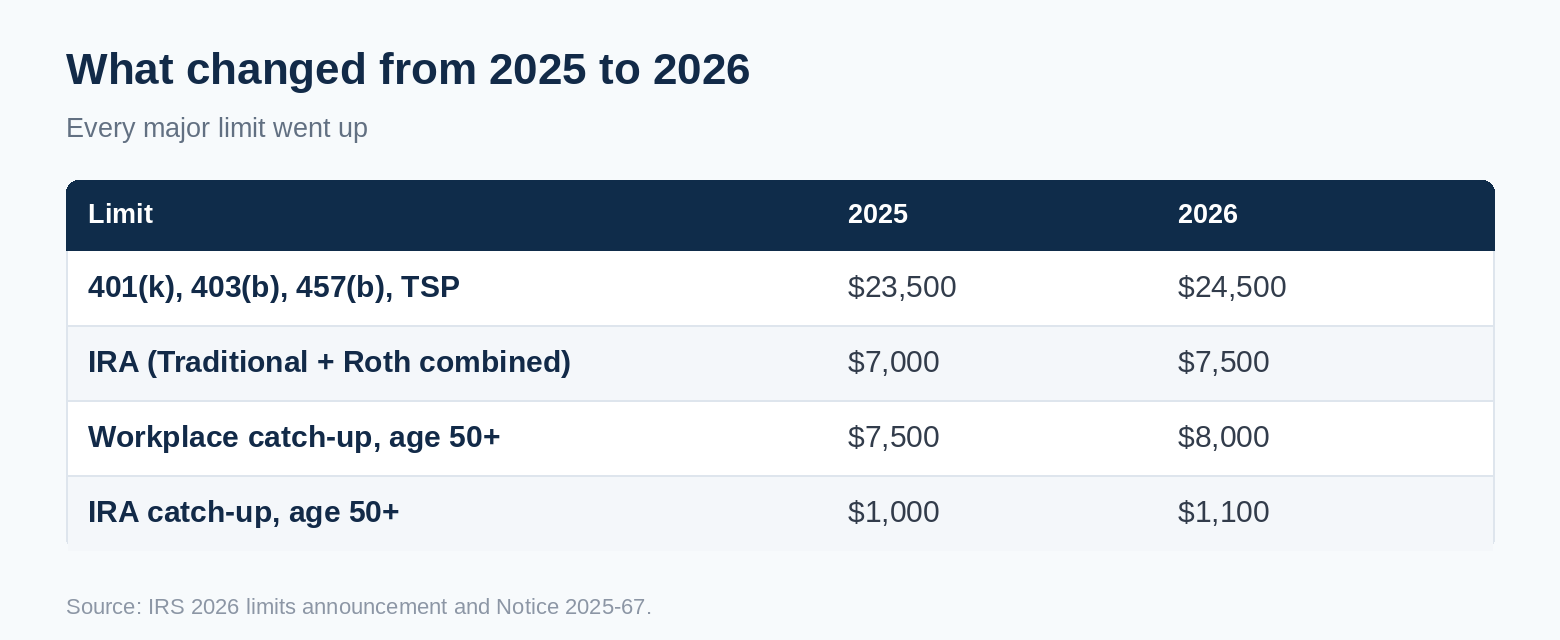
For comparison, the 2025 limits were $23,500 for workplace plans, $7,000 for IRAs, a $7,500 workplace catch-up and a $1,000 IRA catch-up. HSA figures come from IRS Publication 969.
2027 contribution limits (announced November 12, 2026)
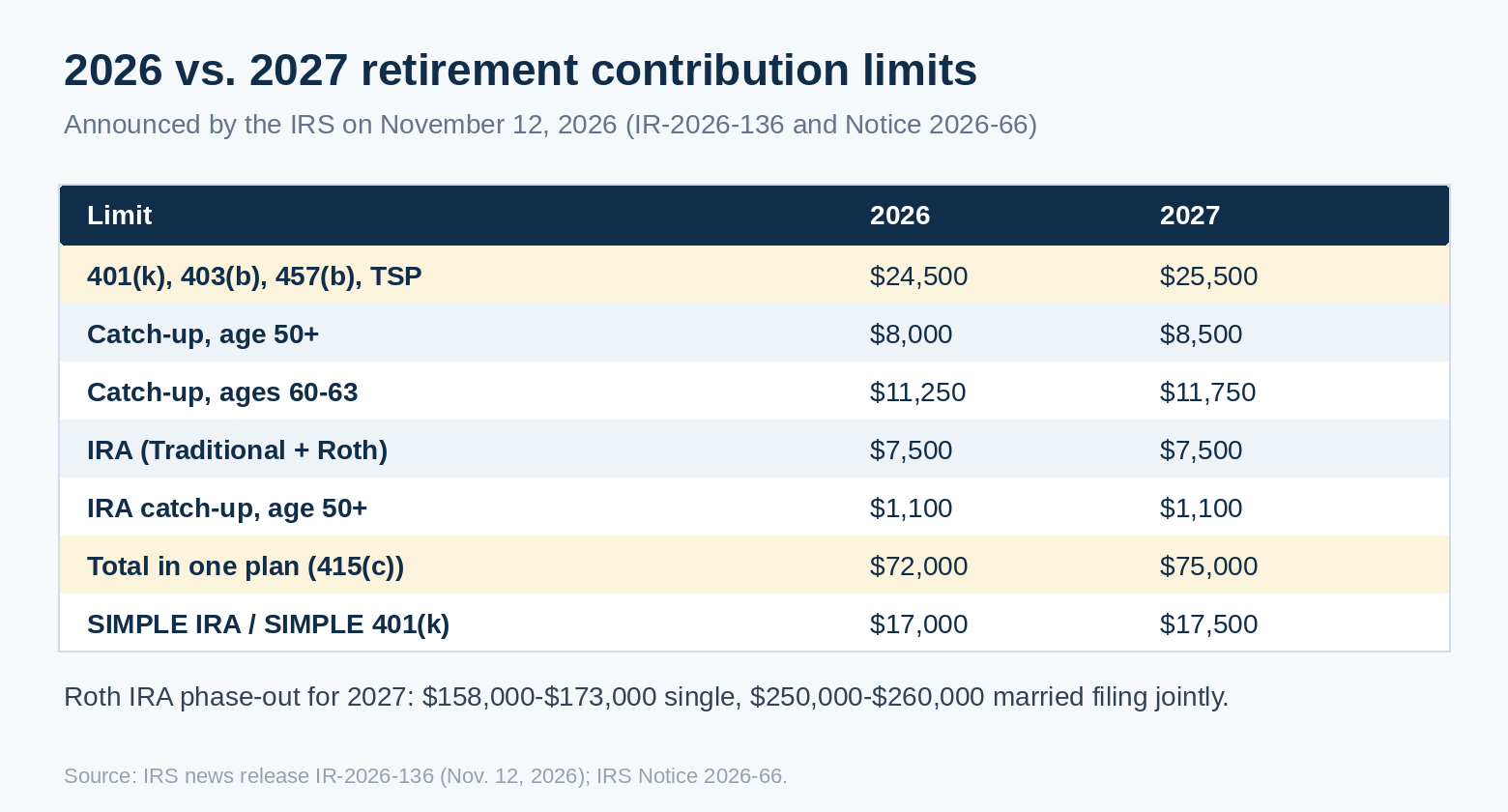
The IRS released the 2027 limits in news release IR-2026-136 and Notice 2026-66. They apply to contributions for calendar year 2027.
| Limit | 2026 | 2027 |
|---|---|---|
| 401(k), 403(b), governmental 457(b), TSP | $24,500 | $25,500 |
| Catch-up, age 50+ | $8,000 | $8,500 (total $34,000) |
| Catch-up, ages 60–63 | $11,250 | $11,750 (total $37,250) |
| Traditional or Roth IRA (combined) | $7,500 | $7,500 |
| IRA catch-up, age 50+ | $1,100 | $1,100 |
| Total into one defined-contribution plan (415(c)) | $72,000 | $75,000 |
| SIMPLE IRA / SIMPLE 401(k) | $17,000 | $17,500 ($19,100 for certain plans) |
| SIMPLE catch-up: 50+ / ages 60–63 | $4,000 / $5,250 | $4,000 / $5,250 |
| 2027 income phase-out (MAGI) | Single / head of household | Married filing jointly |
|---|---|---|
| Roth IRA contribution phases out | $158,000–$173,000 | $250,000–$260,000 |
| Traditional IRA deduction phases out (you’re covered by a workplace plan) | $83,000–$93,000 | $133,000–$153,000 |
| Traditional IRA deduction phases out (only your spouse is covered) | — | $250,000–$260,000 |
Roth catch-up threshold for 2027: if your FICA wages from your employer were above $155,000 in 2026, your 2027 catch-up contributions to that employer’s plan must be Roth (Notice 2026-66). The 2027 HSA limits are set separately and are not covered by these announcements; the 2026 HSA figures above still apply for 2026.
401(k), 403(b) and 457(b) limits for 2026
- $24,500 is your personal limit, not a per-plan limit. If you contribute to both a 401(k) and a 403(b) in the same year, your combined employee deferrals can’t go over $24,500 (plus any catch-up you qualify for).
- A governmental 457(b) is the big exception. It has its own separate $24,500 limit. Teachers, nurses at public hospitals and other government workers who have both a 403(b) and a 457(b) can contribute the full amount to each.
- Employer money is counted separately. Your contributions plus your employer’s match and profit-sharing can reach $72,000 in one plan for 2026, which is why a generous match matters so much.
- Long-service 403(b) catch-up. If your plan allows it, employees with at least 15 years at the same hospital, school system, church or similar employer may be able to add up to $3,000 more per year (lifetime cap of $15,000), per the IRS 403(b) limits page.
Catch-up contributions: 50+, and the 60–63 “super catch-up”
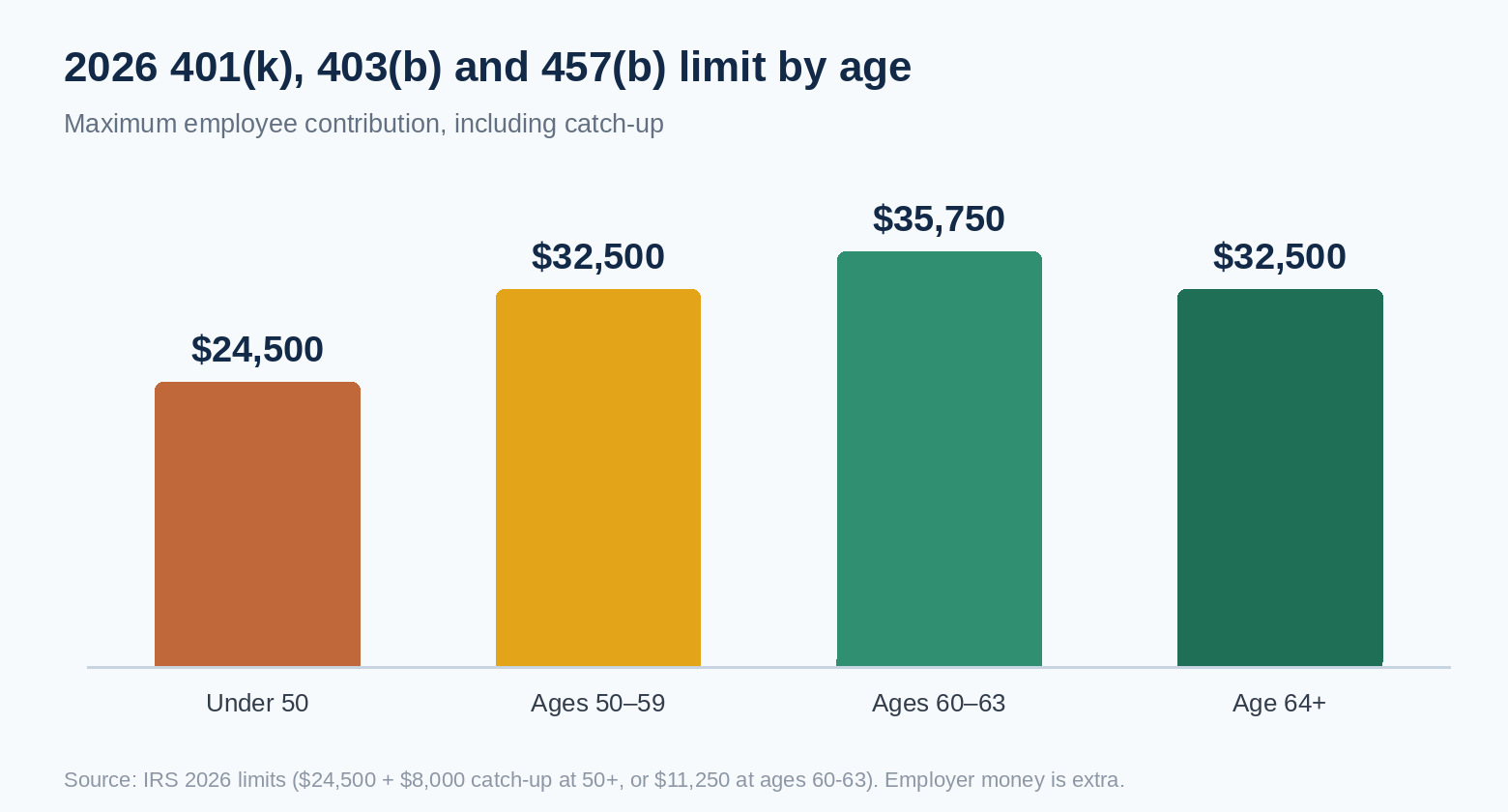
Once you turn 50 (any time during the year counts), you can add $8,000 to a 401(k), 403(b), governmental 457(b) or TSP in 2026, for a total of $32,500. If you turn 60, 61, 62 or 63 during 2026, the SECURE 2.0 Act raises that catch-up to $11,250, for a total of $35,750. At 64 you drop back to the regular $8,000 catch-up.
New for 2026 — Roth catch-ups for higher earners. If your FICA wages from your employer were above $150,000 in 2025, the catch-up contributions you make to that employer’s plan in 2026 must go in as Roth (after-tax) contributions, according to IRS Notice 2025-67. Your regular $24,500 can still be pre-tax. Ask HR how your plan is handling this.
IRA limits for 2026
You can contribute up to $7,500 across all of your Traditional and Roth IRAs combined, or $8,600 if you’re 50 or older. You need earned income at least equal to what you put in (a non-working spouse can use a spousal IRA). Two income tests can limit what you get out of it:
| 2026 income phase-out (MAGI) | Single / head of household | Married filing jointly |
|---|---|---|
| Roth IRA contribution phases out | $153,000–$168,000 | $242,000–$252,000 |
| Traditional IRA deduction phases out (you’re covered by a workplace plan) | $81,000–$91,000 | $129,000–$149,000 |
| Traditional IRA deduction phases out (only your spouse is covered) | — | $242,000–$252,000 |
If you’re married filing separately and lived with your spouse, both phase-outs run from $0 to $10,000. Above the Roth range, many people use a “backdoor” Roth (a nondeductible Traditional IRA contribution converted to Roth). The pro-rata rules in IRS Publication 590-A can make that taxable, so check before you do it. Not sure which type fits you? Our Roth vs. Traditional guide walks through the trade-off.
SIMPLE IRA, SEP IRA and Solo 401(k)
- SIMPLE IRA: $17,000 employee deferral for 2026, plus a $4,000 catch-up at 50+ ($5,250 at ages 60–63). Some SIMPLE plans qualify for a higher $18,100 limit (catch-up $3,850); your plan administrator can tell you which applies.
- SEP IRA and Solo 401(k): total contributions are capped by the $72,000 defined-contribution limit for 2026. A Solo 401(k) lets you contribute both as “employee” (up to $24,500, plus catch-up) and as “employer,” so it usually shelters more at modest self-employment incomes.
What to fund first
- Get the full employer match. It’s the best return available and doesn’t count against your $24,500.
- If you have a high-deductible health plan, consider the HSA. See how to use an HSA for retirement.
- Then an IRA or more workplace-plan savings, depending on your plan’s fees and investment choices.
To see what maxing out would actually be worth, plug your numbers into the retirement savings calculator, then check your target with how much do you need to retire. The compound interest calculator shows what an extra $1,000 a year can grow to.
Want the official text behind any figure? The IRS publications are linked from our directory’s IRAs and Roth IRAs and workplace plans resources.
Common questions
What is the 401(k) contribution limit for 2026?
$24,500 in employee deferrals, plus an $8,000 catch-up at 50+ or an $11,250 catch-up at ages 60–63.
What is the IRA contribution limit for 2026?
$7,500 across all your IRAs combined, or $8,600 if you’re 50 or older.
What are the 2026 Roth IRA income limits?
The ability to contribute phases out between $153,000 and $168,000 (single) and $242,000 and $252,000 (married filing jointly).
Can I contribute to both a 403(b) and a 457(b)?
Yes. A governmental 457(b) has its own $24,500 limit, separate from the 403(b).
Do my catch-up contributions have to be Roth in 2026?
Only if your FICA wages from that employer were above $150,000 in 2025.
What is the 401(k) contribution limit for 2027?
$25,500, up from $24,500 for 2026. The age 50+ catch-up rises to $8,500 (total $34,000) and the ages 60 to 63 catch-up to $11,750. Source: IRS news release IR-2026-136.
What is the IRA contribution limit for 2027?
It stays at $7,500, with a $1,100 catch-up at 50 or older. The 2027 Roth IRA phase-out is $158,000 to $173,000 for single filers and $250,000 to $260,000 for married couples filing jointly.
Sources
- IRS — 401(k) limit increases to $25,500 for 2027, IRA limit remains $7,500 (IR-2026-136, Nov. 12, 2026)
- IRS Notice 2026-66 — 2027 amounts relating to retirement plans and IRAs (415(c) limit, Roth catch-up wage threshold)
- IRS — 401(k) limit increases to $24,500 for 2026, IRA limit increases to $7,500
- IRS Notice 2025-67 — 2026 amounts relating to retirement plans and IRAs (415(c) limit, Roth catch-up wage threshold)
- IRS — 403(b) contribution limits (15-year service catch-up)
- IRS Publication 969 (2026 HSA limits)
- IRS Publication 590-A (IRA contributions)
Try it: Retirement Savings Projection
See what your savings could grow to by the age you want to retire. Everything runs in your browser, and nothing you type is sent anywhere.
Estimates only, based on the numbers you enter. Open the full Retirement Savings Projection or see all calculators.

Comments
No comments yet — be the first to share your thoughts.
Sign in or create an account to comment.