 Data & limits
How Much Do You Need to Retire? By Household, With Real Numbers
How much do you need to retire? It depends on your life. A single renter, a mortgage-free homeowner, a couple, and a family need very different amounts. Here's the simple formula, the bare-minimum floor, and specific nest-egg targets for each household type.
“How much do I need to retire?” has no single answer, because a single renter, a mortgage-free homeowner, a retired couple, and a family supporting others live on wildly different budgets. But there is a simple way to size your number — and once you see it applied to real household types, the target stops feeling mysterious.
The one formula that sizes your number
Almost every ‘how much’ answer comes from one guideline: the 25× rule (the flip side of the 4% rule). Multiply the yearly spending you need to cover by 25, and that’s roughly the nest egg that could sustain it for a ~30-year retirement.
But there’s a crucial shortcut most people miss: you don’t have to fund your whole budget from savings. Social Security covers a chunk of it. So the real formula is:
- Nest egg needed ≈ (yearly spending − Social Security) × 25
That gap — what’s left after Social Security — is the part your savings actually has to cover. It’s why a modest lifestyle plus two Social Security checks can require surprisingly little, while a high-spending household needs a lot.
How much for different households
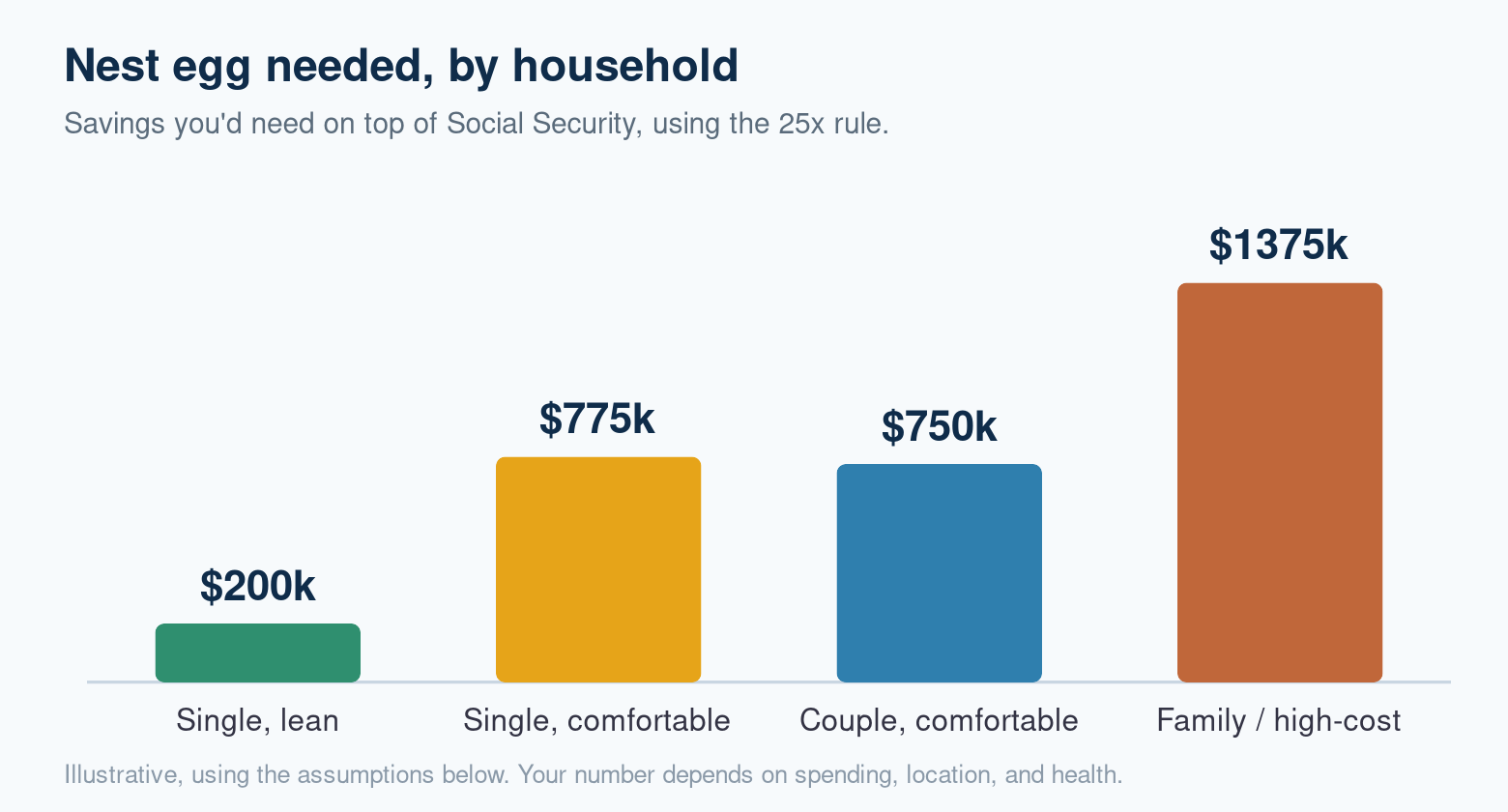
Here are specific targets for common situations. Each uses the formula above, with rough Social Security estimates (an average retired worker gets roughly $22,000–$24,000 a year; a couple with two benefits, around $40,000).
| Household | Yearly spending | Social Security (est.) | You fund yourself | Nest egg needed (25×) |
|---|---|---|---|---|
| Single renter — bare minimum | $30,000 | $22,000 | $8,000 | ~$200,000 |
| Single, home paid off | $40,000 | $24,000 | $16,000 | ~$400,000 |
| Single — comfortable | $55,000 | $24,000 | $31,000 | ~$775,000 |
| Couple — bare minimum | $45,000 | $40,000 | $5,000 | ~$125,000 |
| Couple, home paid off — comfortable | $70,000 | $40,000 | $30,000 | ~$750,000 |
| Family / high-cost / supporting others | $95,000 | $40,000 | $55,000 | ~$1,375,000 |
What ‘bare minimum’ really means
The true floor is living mostly on Social Security, with just a small cushion on top. As the table shows, a frugal single renter might get by with a nest egg near $150,000–$200,000, and a couple with two benefits even less — because their combined Social Security covers most of a modest budget.
But ‘bare minimum’ comes with real trade-offs. Cutting it that close usually means:
- Little buffer for emergencies, a bad market year, or a big medical bill.
- Housing pressure if you rent — rent rises with inflation, while a paid-off home does not.
- No room for the fun stuff — travel, hobbies, helping family.
- Heavy reliance on Social Security, so any future benefit change hits harder.
A safer ‘minimum’ for most people is enough savings to cover essential spending above Social Security with a cushion — often $250,000–$400,000 for a single person, depending on housing.
The five things that move your number the most
- Do you own your home outright? This is the single biggest lever. A paid-off home can cut yearly spending by many thousands and slash the nest egg you need. A renter needs meaningfully more.
- Single vs. couple. Couples get two Social Security checks and share fixed costs (one home, one utility bill), so they often need less per person than a single retiree — the ‘two can live cheaper than two ones’ effect.
- Healthcare. Often the largest wild card, especially before Medicare at 65 and for long-term care later. Build in a real cushion for it.
- Where you live. Housing, taxes, and cost of living vary enormously by state and city — the same lifestyle can cost 40% more in one place than another.
- When you claim Social Security. Claiming at 62 permanently shrinks your benefit; waiting toward 70 grows it — and a bigger benefit directly shrinks the nest egg you need.
Retiring early? You need more, not less
Every number above assumes Social Security is helping. If you retire before 62, you must fund your entire budget from savings until benefits begin — and over a longer retirement. Early retirees also often use a more conservative 3–3.5% withdrawal rate (roughly 28–33× spending) to make the money last decades longer.
Find your own number
These scenarios are starting points — your real target comes from your own spending and Social Security estimate. Plug your numbers into the free Retirement Portfolio Analyzer or the How Much Do I Need calculator to see your target in seconds.
The bottom line
There’s no universal ‘number’ — there’s your number, and it’s mostly driven by your yearly spending minus Social Security, times 25. Owning your home, being part of a couple, and claiming Social Security later all shrink it; renting, high-cost areas, healthcare, and retiring early all raise it. Estimate your spending honestly, subtract your benefit, multiply by 25, and you’ll have a target worth building toward.
Educational information only, not financial advice. The dollar figures are illustrative examples built from the 25× rule and the stated assumptions; your real number depends on your spending, location, health, and Social Security. Confirm your own benefit estimate at SSA.gov.

Comments
No comments yet — be the first to share your thoughts.
Sign in or create an account to comment.