 Retirement goals
Is Social Security Raising the Retirement Age?
The Social Security 'full retirement age' has already risen from 65 to 67, and proposals to raise it further come up regularly. Here's what's actually changed, what's being proposed, and how to plan through the uncertainty.
'Are they raising the retirement age?' is one of the most common — and most anxiety-inducing — Social Security questions. The honest answer: they already did once, and more changes are debated regularly, but nothing new is law yet.
What already changed
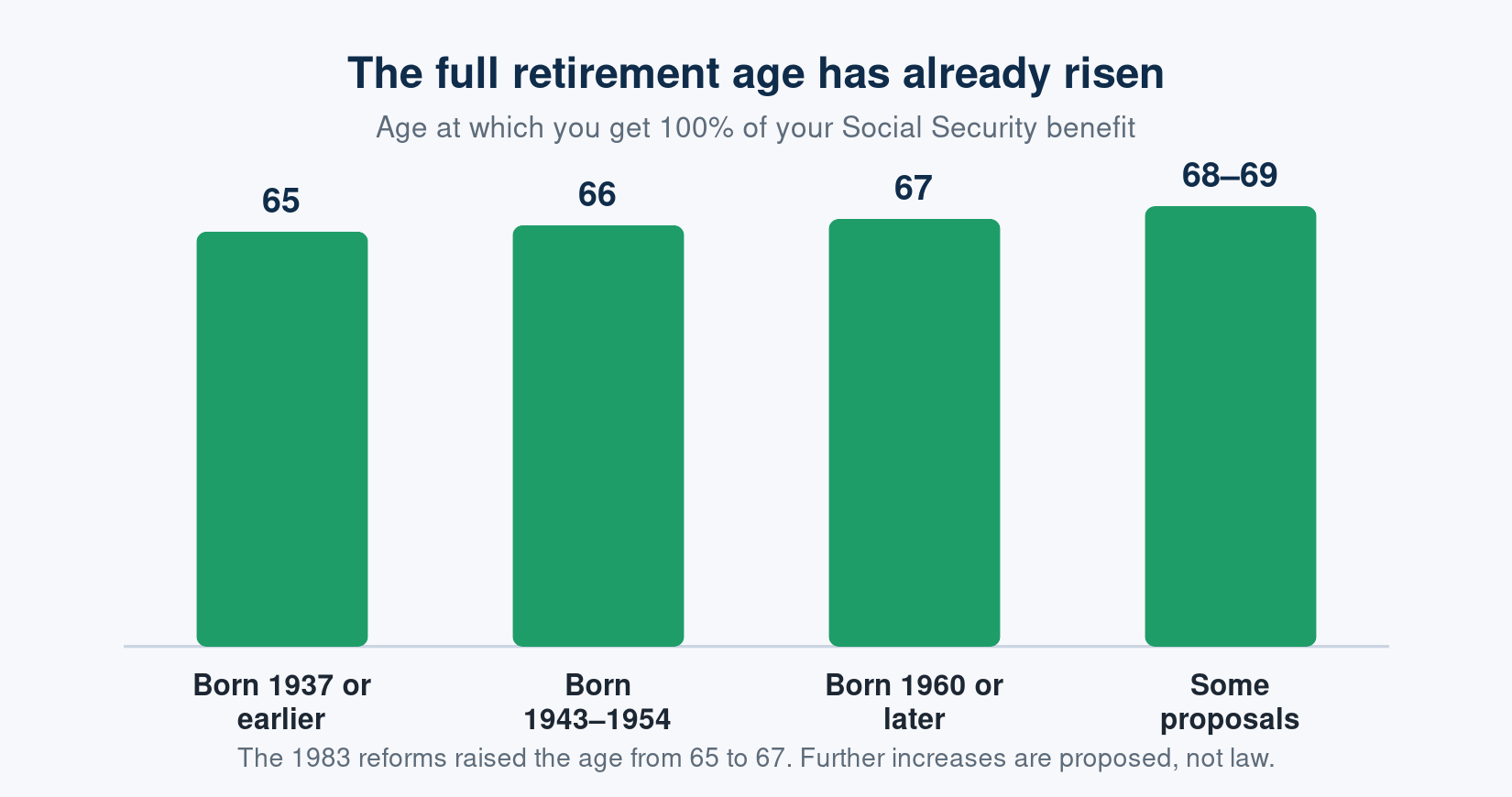
The 'full retirement age' — when you get 100% of your benefit — used to be 65. The 1983 Social Security reforms gradually raised it to 67 for anyone born in 1960 or later. If you assumed 65, your full age is likely already 67.
Why more changes are proposed
Social Security's trust funds are projected to face a shortfall in the coming years as more people retire and live longer. To address it, policymakers periodically propose options like raising the full retirement age further (to 68 or 69), adjusting the benefit formula, or changing the payroll-tax cap. These are proposals, not current law.
What it would mean for you
- Raising the full retirement age effectively cuts benefits for a given claiming age — you'd get less at 67 than you do today, or have to wait longer for the same amount.
- Changes are typically phased in and usually spare those already at or near retirement.
- The earliest claiming age (62) and the delayed-credit ceiling (70) could also shift in some proposals.
How to plan through the uncertainty
You can't control policy, but you can build a plan that's resilient to it:
- Don't assume today's rules are permanent if you're decades away — build in a margin.
- Save independently so Social Security is a supplement, not the whole plan.
- Check your own estimate at ssa.gov, which reflects current law for your birth year.
- Stay flexible on your own retirement age so you can adapt if rules change.
The safest assumption isn't a specific future age — it's a plan sturdy enough to handle a few different ones.
Educational information only — not financial, tax, or legal advice. Figures are illustrative; verify against your own accounts and consult a qualified professional.

Comments
No comments yet — be the first to share your thoughts.
Sign in or create an account to comment.