 Retirement goals
What Is a Retirement Age?
There isn't one retirement age — there are several, each unlocking something different: penalty-free withdrawals, Social Security, Medicare, and required withdrawals. Here's what each key age actually means.
People talk about 'retirement age' as if it's a single number. It isn't. In the U.S., several different ages each unlock a different piece of retirement — and mixing them up is a common, costly mistake.
59½ — penalty-free retirement accounts
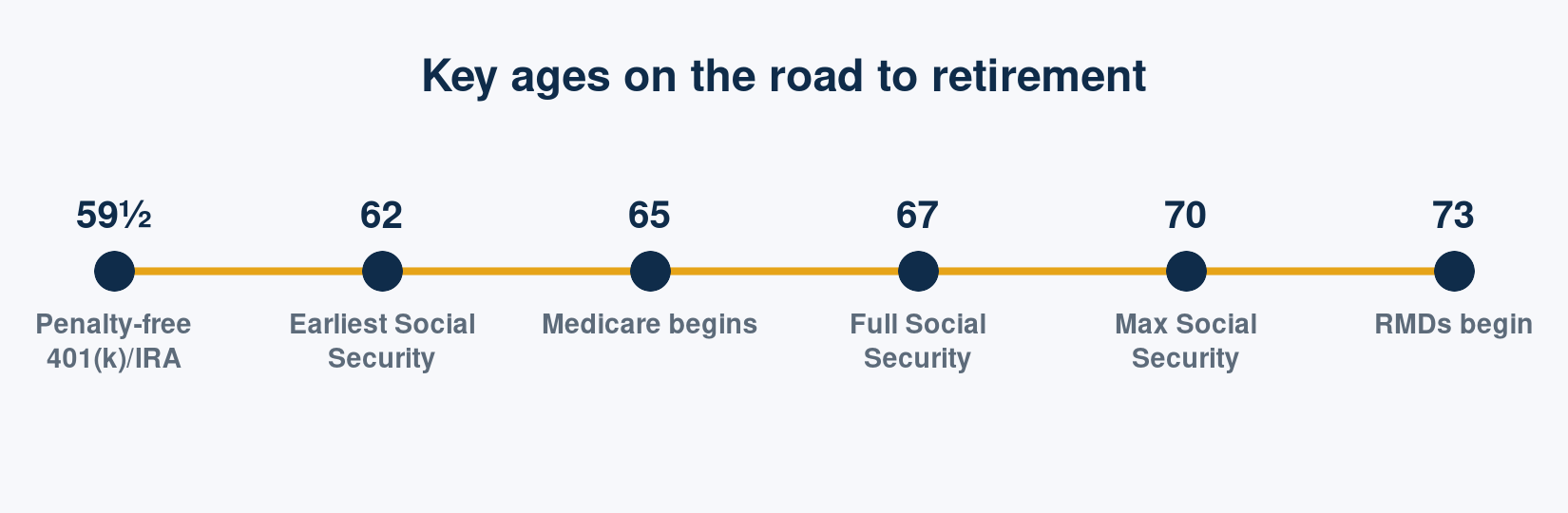
This is the age you can generally withdraw from a 401(k) or IRA without the 10% early-withdrawal penalty. It's the first 'retirement age' for your own savings — separate from Social Security entirely.
62 — earliest Social Security
The youngest age you can claim Social Security retirement benefits — at a permanently reduced amount.
65 — Medicare
Medicare eligibility begins at 65, regardless of your Social Security choices. Because health care is a major retirement cost, 65 is a pivotal age even for people who keep working.
66–67 — full retirement age
Your 'full retirement age' for Social Security — 67 for anyone born in 1960 or later — is when you receive 100% of your calculated benefit. This is the number most people mean by 'retirement age,' but as you can see, it's just one of many.
70 — maximum Social Security
Delaying past full retirement age grows your benefit until 70, after which there's no further increase.
73 — required minimum distributions
Eventually the government requires you to start withdrawing from tax-deferred accounts. Under current rules that begins at 73 (rising to 75 later this decade). Miss an RMD and the penalty is steep.
So what's your retirement age? It depends which door you're trying to open. Plan around all of them, not just one.
Educational information only — not financial, tax, or legal advice. Figures are illustrative; verify against your own accounts and consult a qualified professional.

Comments
No comments yet — be the first to share your thoughts.
Sign in or create an account to comment.