 Crypto & retirement
How to Buy a Bitcoin ETF in a Roth IRA
Since the first U.S. spot Bitcoin ETFs launched in January 2024, you no longer need a crypto exchange, a wallet, or a set of private keys to own Bitcoin exposure in retirement. You can buy a Bitcoin ETF inside an ordinary Roth IRA at a mainstream brokerage — and every dollar of qualified growth comes out tax-free. This guide walks through exactly how to do it, which brokerages allow it, and what to watch for.
Why a Roth IRA is a great home for a Bitcoin ETF
Bitcoin is a high-volatility, high-upside asset. That combination is precisely what makes a Roth so attractive as its container:
- Tax-free growth. Qualified Roth withdrawals (after age 59½ and the 5-year rule) are 100% tax-free. If your ETF appreciates significantly over the years, you owe nothing on those gains — unlike a taxable account, where every sale triggers capital-gains tax.
- No tax drag while it grows. Rebalancing or trimming a hot position inside a Roth creates no taxable event, so you never worry about capital gains, wash sales, or a pile of 1099s.
- Asymmetric payoff, sheltered. Sheltering your highest-variance holding in the account with the best tax treatment is a sensible way to let a speculative bet run without a tax bill if it works out.
Spot Bitcoin ETF vs. buying Bitcoin directly
A spot Bitcoin ETF holds actual Bitcoin and trades like a stock in your brokerage account. You get the price exposure without managing a wallet, seed phrase, or a crypto exchange. Most IRAs cannot hold Bitcoin directly (that requires a specialized “crypto IRA” custodian), but they can hold an ETF exactly like any other fund — which is why the ETF is the simplest way to get Bitcoin into a normal Roth IRA.
Favor spot ETFs (which hold real Bitcoin) over futures ETFs (which hold futures contracts and can drift from Bitcoin's price). The major spot Bitcoin ETFs, all launched in January 2024, include:
- iShares Bitcoin Trust — IBIT (BlackRock)
- Fidelity Wise Origin Bitcoin Fund — FBTC
- ARK 21Shares Bitcoin ETF — ARKB
- Bitwise Bitcoin ETF — BITB
- Grayscale Bitcoin Trust — GBTC (and the lower-fee Grayscale Bitcoin Mini Trust, BTC)
- Franklin EZBC, VanEck HODL, Invesco Galaxy BTCO, Valkyrie BRRR
Expense ratios on the newer funds cluster around 0.19%–0.25%; GBTC is a notable outlier at roughly 1.5%. Fees compound over decades, so the ratio is worth a look before you choose.
How to buy a Bitcoin ETF in your Roth IRA, step by step
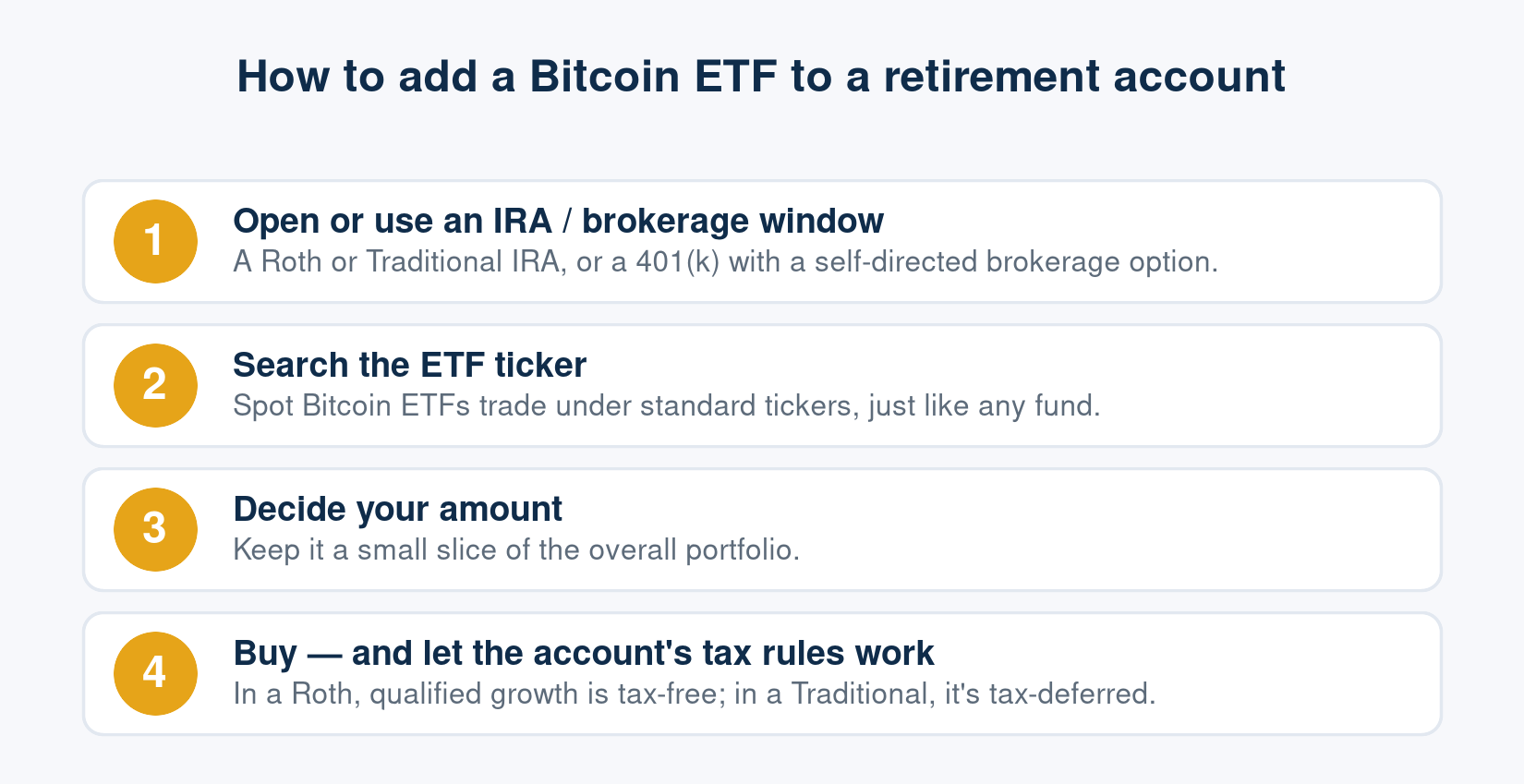
- Use a brokerage that allows it. You need a Roth IRA at a broker that offers a normal ETF-trading window and doesn't block spot Bitcoin ETFs. Fidelity, Charles Schwab, E*TRADE, Merrill, and Robinhood all allow it, among others. One important exception: Vanguard does not permit buying spot Bitcoin ETFs on its platform — if you're at Vanguard, you'd open or move a Roth elsewhere. Don't have a Roth yet? Opening one takes minutes; just confirm you're under the Roth income limits first.
- Fund the Roth. Contribute up to the annual limit — $7,000 for 2024–2025, or $8,000 if you're 50 or older — or move money from an existing Roth. Contributions go in as cash; you buy the ETF once the money lands. (Roth eligibility phases out at higher incomes; above the limit, a “backdoor Roth” is an option — check with a tax professional.)
- Find the ticker. Search the fund's symbol (for example IBIT or FBTC) in your broker's trade screen. It looks up exactly like any stock or fund.
- Place the order. Enter the number of shares (or a dollar amount, if your broker supports fractional/dollar-based ETF orders), choose market (fills right away) or limit (fills only at your price), and submit. ETFs trade only during U.S. market hours (about 9:30 a.m.–4 p.m. ET), even though Bitcoin itself trades 24/7 — so an order placed overnight fills at the next open.
- Confirm, then let the Roth do its job. Once the trade settles (typically the next business day), the ETF sits in your Roth like any other holding. From there, all future appreciation and qualified withdrawals are tax-free.
What to watch out for
- Position size. Bitcoin has repeatedly fallen 50%–70% from its highs. Many advisors suggest keeping speculative crypto to a small slice of the overall portfolio — often in the 1%–5% range — sized so a deep drawdown wouldn't derail your retirement plan.
- Expense ratio. Prefer the low-fee spot funds; over decades, 0.2% versus 1.5% is a meaningful drag.
- Broker limitations. As noted, Vanguard blocks these ETFs, and a few smaller custodians may too — confirm before you fund the account.
- Contribution & income limits still apply. The ETF doesn't change the Roth's annual cap or the MAGI phase-outs.
- The ETF isn't 24/7. It prices only during market hours, so it can gap up or down versus Bitcoin's overnight moves.
The bottom line
A spot Bitcoin ETF is the simplest way to hold Bitcoin exposure in a Roth IRA: buy it like any fund at a broker that allows it, keep the position modest, and let the Roth's tax-free growth work on an asset with real upside. Decide the allocation that fits your risk tolerance first — then the mechanics are no harder than buying any other ETF.
Educational information only — not financial, tax, or legal advice. Investing in Bitcoin and Bitcoin ETFs carries significant risk, including the possible loss of principal. Consider your own situation and consult a qualified professional before investing.
Related: for the full picture, see our pillar guide on holding crypto in a Roth IRA, and model tax-free growth with the compound-interest calculator.

Comments
No comments yet — be the first to share your thoughts.
Sign in or create an account to comment.