 Careers
Retirement Planning for Speech-Language Pathologists: School, Hospital & Private Practice
For a speech-language pathologist (SLP), the place you work decides most of your retirement plan. A school SLP may earn a state pension plus a 403(b) or 457(b). A hospital SLP usually gets a 403(b) or 401(k). A private-practice or contract SLP has to build everything alone. The Bureau of Labor Statistics (BLS) counts about 193,400 SLP jobs in 2025, with a median wage of $97,870 (May 2025), spread across very different settings (BLS Occupational Outlook Handbook). This guide covers each one, with 2026 limits.
Where SLPs work and what each setting pays
BLS reports that 39% of SLPs work in educational services, 25% in offices of physical, occupational and speech therapists and audiologists, 13% in hospitals, 5% in nursing and residential care facilities, and 5% are self-employed. Median pay differs a lot by setting:
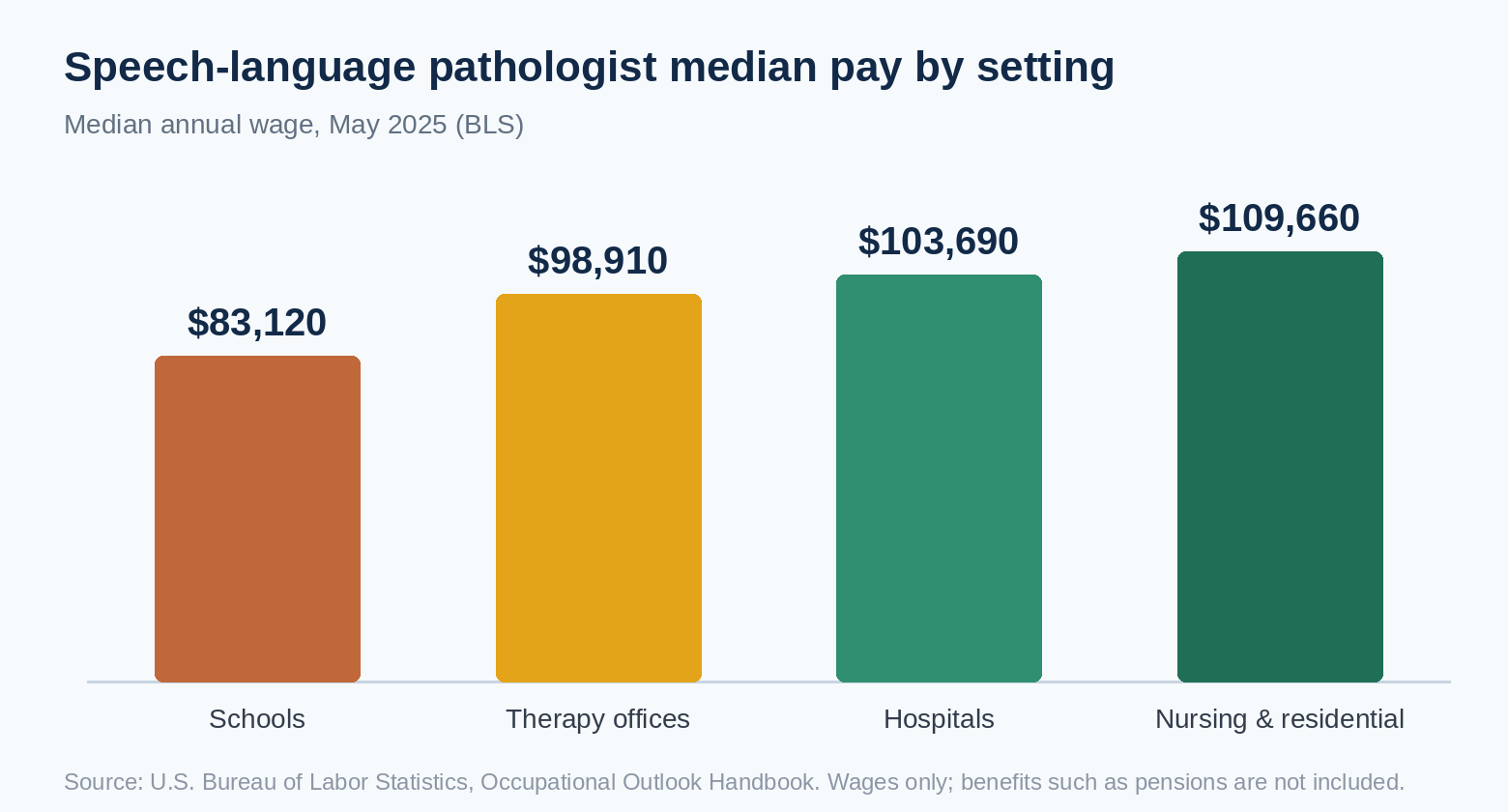
Schools pay the least in wages. But wages leave out benefits, and the retirement benefits in public schools are often the strongest of any setting. In March 2026, 93% of state and local government workers in elementary and secondary schools had access to a retirement plan, compared with 72% of private-industry workers in health care and social assistance (BLS Employee Benefits, Table 1). When you compare job offers, compare the whole package, not just salary.
Your plan, by setting
| Setting | Typical plans | Watch for |
|---|---|---|
| Public school district | State or local pension, plus a 403(b) and often a 457(b) | Vesting years, whether your job is in Social Security, and high-fee 403(b) vendors |
| Private school or nonprofit hospital | 403(b), sometimes a pension | Match formula and fund fees |
| Public or university hospital | 403(b) and/or governmental 457(b), sometimes a pension | You may be able to use two separate limits |
| Therapy clinic, home health, staffing agency | 401(k) | Waiting periods and vesting on the match |
| Private practice or 1099 contract | Solo 401(k) or SEP IRA | You set it up and fund it yourself |
School SLPs: making the most of a pension
If your district gives you a pension, it's likely your biggest retirement asset. Find these answers in your retirement system's member handbook:
- Which system covers you. In many states, school SLPs belong to the same retirement system as teachers. In others they're in a general state or school-employee system. The rules differ, so read your own system's handbook rather than a teacher's.
- When you vest. Leave before you're vested and you may only get back your own contributions. After you vest, you may be able to leave and claim a smaller pension later.
- How the formula works. Most formulas multiply years of service by a percentage and an average of your highest salaries. Texas TRS, for example, uses 2.3% per year of service; our Texas TRS vs. 403(b) guide shows how that math works.
- Service credit you can buy. Some systems let you buy credit for earlier work, such as time at a private or out-of-state school. It can be a good deal, but get the price in writing and compare it with the extra pension it buys.
- Return-to-work rules. Many retired SLPs go back part time. Systems often limit how much a retiree can earn from a covered employer without losing pension checks, and some make exceptions for hard-to-fill jobs. Check before you accept a post-retirement contract.
Social Security for school SLPs
Some school districts don't take part in Social Security. For decades, two rules (the Windfall Elimination Provision and the Government Pension Offset) cut the Social Security that people with those pensions earned from other jobs or as a spouse. The Social Security Fairness Act, signed January 5, 2025, ended both for benefits payable for months after December 2023 (SSA: Social Security Fairness Act). If you also worked in a clinic or private practice, check your record in your my Social Security account. Our guide to teacher retirement covers the pension-plus-Social Security picture in more detail.
403(b) and 457(b) on top of the pension
For 2026 you can defer up to $24,500 into a 403(b), plus $8,000 at 50+ or $11,250 at ages 60–63. A governmental 457(b) has its own separate $24,500 limit, so a district that offers both lets you save up to twice as much (IRS 2026 limits). Governmental 457(b) money also isn't hit with the 10% early-withdrawal tax once you leave that employer, which makes it a useful bridge if you retire before 59½. School 403(b) menus sometimes lean on high-fee annuity products, so compare the costs of every vendor on your district's list before you pick one.
Hospital and nursing-facility SLPs
Hospital SLPs usually get a 403(b) (nonprofit) or 401(k) (for-profit), and public hospitals may add a 457(b) or pension. If your 403(b) plan allows it, 15 years of service at the same hospital or health system can unlock up to $3,000 a year of extra catch-up room, with a $15,000 lifetime cap (IRS 403(b) limits). Our retirement guide for healthcare workers covers 403(b) and 457(b) rules, including the risks of a non-governmental 457(b).
Private practice, PRN and contract SLPs
About 1 in 20 SLPs is self-employed, and many more pick up 1099 work on the side. With self-employment income, a Solo 401(k) lets you contribute as the "employee" (up to $24,500 in 2026) and as the "employer," up to a $72,000 total per plan (IRS Notice 2025-67). The employer part is limited to a share of your net self-employment earnings, and a SEP IRA allows only that employer part (IRS Publication 560).
A school job plus a side practice? The employee limit is shared: your 403(b) and Solo 401(k) deferrals together can't go over $24,500 (plus catch-up). A governmental 457(b) has its own separate limit, and Solo 401(k) employer contributions don't count against the $24,500 employee limit. One catch: a 403(b) and a plan for a business you control can share the $72,000 overall cap, so have a tax professional check the total. For a school SLP with a busy side practice, that combination can still shelter far more than one plan alone.
What to do this week
- Find out which plans you have: pension, 403(b), 457(b), 401(k) or none. Get any match first.
- If you have a pension, look up your vesting date and your estimated benefit in your retirement system's member portal.
- Check your Social Security record, especially if you've worked in both schools and clinics.
- Estimate your target with the how much do you need to retire calculator, subtracting the income your pension and Social Security are expected to cover.
- Test whether your savings rate closes the gap with the retirement savings calculator, and try an earlier retirement date in the savings goal calculator.
For other careers, see retirement planning by profession.
Common questions
Do speech-language pathologists get a pension?
Many in public schools and some in public hospitals do. SLPs in private clinics, home health and private practice usually don't and rely on a 401(k), 403(b) or their own Solo 401(k) or IRA.
Can a school SLP contribute to both a 403(b) and a 457(b)?
Yes, if the district offers both. A governmental 457(b) has its own limit, so in 2026 you can defer up to $24,500 into each, plus catch-up contributions if you qualify.
Do school SLPs get Social Security?
It depends on the district. Some take part in Social Security and some don't. Since the Social Security Fairness Act ended the WEP and GPO, a non-covered pension no longer reduces Social Security you earned from other work or as a spouse.
What retirement plan should a private-practice SLP use?
A Solo 401(k) usually allows the most savings for a practice with no employees. A SEP IRA is simpler but allows only employer-style contributions.
Is it better to work in a school or a clinic for retirement?
Schools pay lower median wages ($83,120 vs. $98,910 in therapy offices in May 2025), but public-school jobs often come with a pension. Compare total compensation, including what the pension would pay if you stay long enough to vest.
Sources
- BLS — Occupational Outlook Handbook: Speech-Language Pathologists (jobs, pay by setting, work settings)
- BLS — Employee Benefits in the United States, March 2026, Table 1
- IRS — 2026 retirement plan and IRA limits
- IRS — 403(b) contribution limits
- IRS Notice 2025-67 (total defined-contribution limit)
- IRS Publication 560 (retirement plans for the self-employed)
- SSA — Social Security Fairness Act

Comments
No comments yet — be the first to share your thoughts.
Sign in or create an account to comment.