 Crypto & retirement
Best Crypto IRA (2026): Providers, Fees and How to Choose
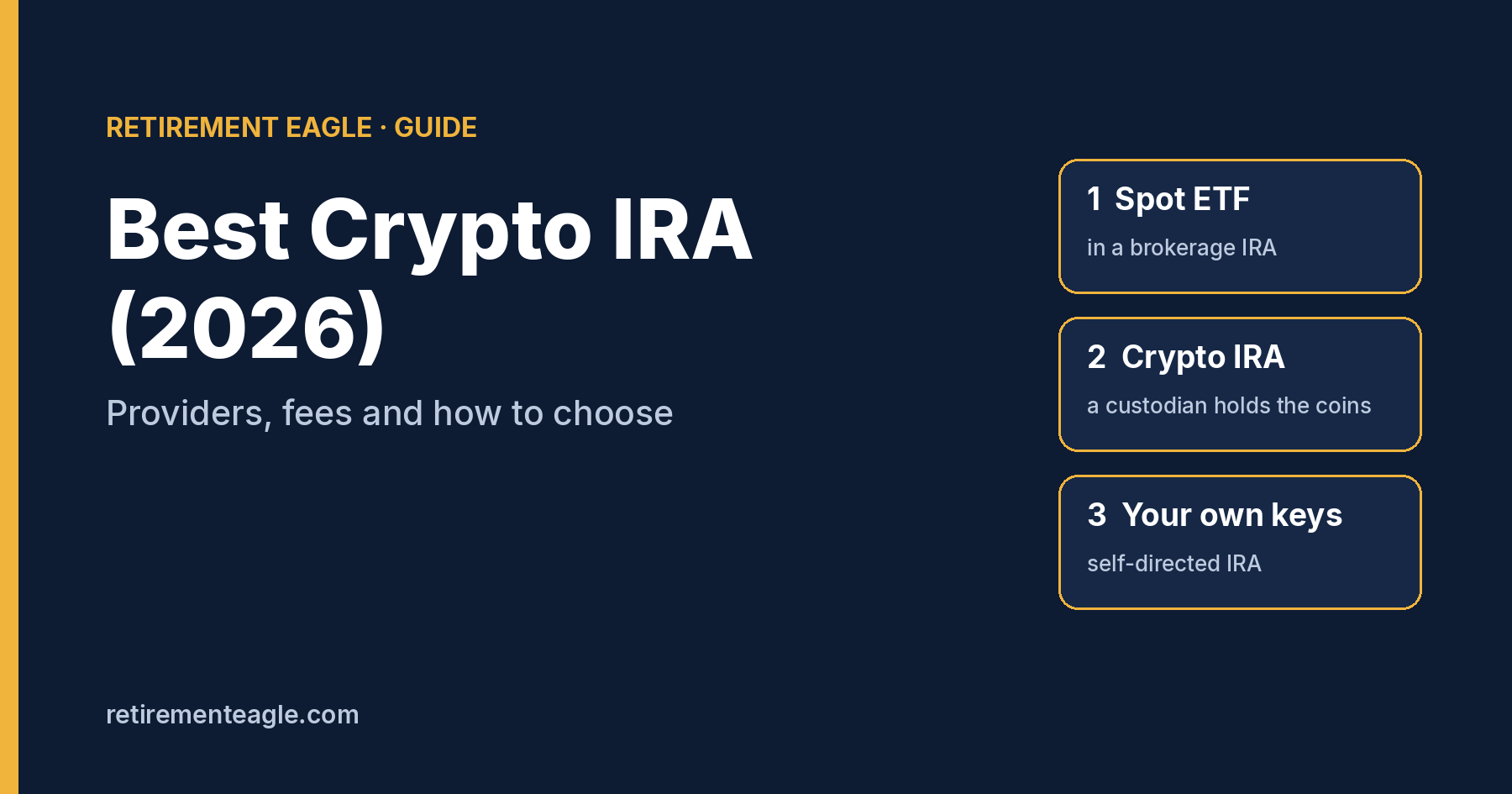
There is no single best crypto IRA. There are three routes, and the best one depends on what you want to own and how much you want to pay. You can buy a spot Bitcoin or ether ETF inside an ordinary brokerage IRA, open a dedicated crypto IRA that holds the coins for you, or use a self-directed IRA where you hold some of the keys. This guide compares all three for Traditional, Roth, SEP and rollover IRAs, lists the main providers with fees taken from their own pages in November 2026, and shows how to pick by the kind of investor you are.
Only want a Roth? Our best Roth IRA for crypto guide goes deeper on the Roth tax rules. This page covers every account type and the choice of provider.
The three routes at a glance
| 1. Spot ETF in a brokerage IRA | 2. Dedicated crypto IRA | 3. Self-directed IRA with your own keys | |
|---|---|---|---|
| What you own | Fund shares | Coins, held by a custodian | Coins in a multisig vault where you hold keys |
| Main cost | Annual expense ratio, about 0.15% to 0.25% for most spot Bitcoin ETFs | A fee on each trade (1% to 2% at the providers below), sometimes a monthly fee | Annual account fee plus trade fees |
| Who holds the keys | The fund's custodian | The IRA custodian | You hold some keys; a custodian holds title |
| Coin choice | Mostly Bitcoin and ether | From 1 to about 100 coins | Usually Bitcoin only |
| Effort | Low | Medium | High |
How we chose the providers
We did not rank providers by partnership or popularity. A provider made the table below if it met all of these:
- It offers an IRA that holds crypto or spot crypto ETFs to US savers.
- It names the custodian that holds the assets.
- Its fees could be checked on its own website (or, for one provider, in its fee disclosure as cited in an earlier guide).
Providers are listed alphabetically. Where a fee was not published, we say "not stated" rather than guess. This is not a complete list, and fees change, so confirm them before you open an account.
Crypto IRA providers compared
| Provider | Route | IRA types | Trade fee | Account or custody fee | Assets | Custodian |
|---|---|---|---|---|---|---|
| Bitcoin IRA | 2 | Not stated | 2% standard; 1% on its "Freedom" account | Standard account: 0.08% a month ($20 minimum) | Not stated | Digital Trust, with BitGo |
| Fidelity Crypto IRA | 2 | Traditional, Roth, Rollover | 1% | None to open, maintain or for custody | BTC, ETH, LTC, SOL | Fidelity Digital Assets |
| iTrustCapital | 2 | Traditional, Roth, SEP | 1% | $0 monthly or annual fee; $1,000 minimum to open | About 100 coins, plus metals, stocks and ETFs | iTrust Custodial Services and Fortis Bank |
| Onramp | 2 (multisig, no client key) | Traditional, Roth | Not stated for IRAs under 5 BTC | No setup fee; under 5 BTC, $100 a month or $1,000 a year | Bitcoin | Two of three keys needed, held by Onramp, BitGo and CoinCover |
| Public Crypto IRA | 2 | Traditional, Roth | 1.25% on orders over $500 (flat fees below that) | 0.05% a month, less trade fees paid that month | 40+ coins | Alto Trust Co. |
| Swan IRA | 2 | Traditional, Roth | 1% | 0.02% of assets a month, $20 minimum, paid from outside the IRA; $0 setup, transfer and closing fees | Bitcoin | Equity Trust |
| Unchained IRA | 3 | Traditional, Roth, SEP | 1.5% | $250 a year per IRA; no setup fee; $2,000 minimum per funding | Bitcoin | Fortis Bank; you hold 2 of 3 keys |
Sources: each provider's own page, checked November 16, 2026 (links in Sources below). Bitcoin IRA's site could not be reached from our checking location, so its figures come from its fee disclosure as reviewed for our crypto Roth IRA guide earlier in November 2026. For spot ETFs (route 1), the table below lists fund fees.
Route 1: a spot crypto ETF in a brokerage IRA
This is the simplest route. You open or use an IRA at a broker and buy a spot Bitcoin or ether ETF by its ticker, like any other fund. There is no separate custodian to set up and no keys to manage. The cost is the fund's annual expense ratio.
| Fund (ticker) | Holds | Annual fee | Cost per year on $10,000 |
|---|---|---|---|
| Grayscale Bitcoin Mini Trust (BTC) | Bitcoin | 0.15% | $15 |
| Bitwise Bitcoin ETF (BITB) | Bitcoin | 0.20% | $20 |
| iShares Bitcoin Trust (IBIT) | Bitcoin | 0.25% | $25 |
| Fidelity Wise Origin Bitcoin Fund (FBTC) | Bitcoin | 0.25% | $25 |
| Fidelity Ethereum Fund (FETH) | Ether | 0.25% | $25 |
| Grayscale Bitcoin Trust (GBTC) | Bitcoin | 1.50% | $150 |
Where you can buy them:
- Fidelity says you can't buy spot coins in a Fidelity brokerage IRA, but you can buy spot crypto ETPs there, including FBTC and FETH.
- Vanguard allows most third-party crypto ETFs and mutual funds on its brokerage platform, but has no plans to launch its own.
- Other brokers mostly list spot Bitcoin ETFs. Confirm the fund can be bought in an IRA before you move money.
The full fee table, with every major fund, is in our crypto Roth IRA guide, and the steps are in how to buy a Bitcoin ETF in a Roth IRA. The same steps work in a Traditional or rollover IRA.
Route 2: a dedicated crypto IRA
A crypto IRA holds actual coins through a qualified custodian. You fund it with cash, a transfer from another IRA, or a rollover from an old 401(k), then buy inside the account. You can't move the coins to your own wallet while they are in the IRA.
- Fidelity Crypto IRA must be linked to a Fidelity brokerage IRA of the same type, which handles contributions and withdrawals. Crypto can't be transferred in or out, and it isn't available in California or Oregon.
- iTrustCapital has the widest menu here and no monthly fee. Our iTrustCapital review covers custody, FDIC status and its Q strategies. If you want to look at it directly, you can visit iTrustCapital. This is an affiliate link, and Retirement Eagle may earn a commission at no extra cost to you.
- Swan IRA is Bitcoin only. Swan says its monthly fee is charged to outside funds, not the IRA balance, citing IRS rules.
- Public Crypto IRA is the former Alto CryptoIRA. Public bought it in November 2025. Trades run through zerohash, and Alto Trust Co. is the custodian.
- Onramp spreads the keys across three institutions. Moving coins takes two of them, and you hold none, so there is no seed phrase for you or your heirs to lose.
- Bitcoin IRA charges more per trade on its standard account (2%) than the others here.
Route 3: a self-directed IRA with your own keys
Some savers want IRA tax treatment and some control of the keys. There are two ways people do this.
Collaborative custody
In the Unchained IRA, Bitcoin sits in a multisig vault and you hold two of the three keys. Fortis Bank is the IRA custodian. You can check your coins on the blockchain yourself. In return you must protect your keys with hardware wallets and backups. Unchained publishes a $250 yearly fee per IRA and a 1.5% trade fee.
An IRA-owned LLC ("checkbook IRA")
Here a self-directed IRA custodian holds an LLC, and you manage the LLC, which opens its own exchange account. It gives the most control and the most risk. The IRS says that if you engage in a prohibited transaction, the account stops being an IRA as of the first day of that year and is treated as fully distributed (IRS: prohibited transactions). In the McNulty Tax Court case, an IRA owner who took personal possession of IRA assets through an LLC was taxed as if she had taken a distribution. Get a tax professional before you try this.
Some exchanges, such as Kraken, don't offer their own IRA but can be used through a separate self-directed setup (affiliate link; Retirement Eagle may earn a commission). Our Kraken crypto IRA guide explains how.
Which account type: Traditional, Roth, SEP or rollover?
- Roth IRA: no deduction now, but qualified withdrawals are tax-free (IRS). Popular for crypto because big gains are never taxed.
- Traditional IRA: contributions may be deductible, growth is tax-deferred, and withdrawals are taxed as income.
- SEP IRA: for self-employed people and small employers (IRS: SEP). In the table, iTrustCapital and Unchained list SEP accounts.
- Rollover IRA: holds money moved from an old 401(k). Fidelity lists it as its own registration type.
Not sure which to use? See Roth vs. Traditional.
How to choose, by investor type
- You want simple Bitcoin exposure at low cost: a low-fee spot Bitcoin ETF in the IRA you already have. On $10,000, a 0.15% to 0.25% fund costs $15 to $25 a year.
- You already use Fidelity: Fidelity Crypto IRA (coins) or FBTC in your Fidelity IRA (fund). Check your state first.
- You want coins beyond Bitcoin and ether: iTrustCapital (about 100) or Public (40+).
- You want Bitcoin only, held for you: Swan IRA, or Onramp for larger balances.
- You already self-custody and want keys in your IRA: Unchained IRA.
- You are rolling over a big 401(k): compare flat fees against percentage fees at your balance, and use a direct transfer.
Fees to watch
Turn every fee into dollars for your own balance. Here is $10,000 held for one year, using the fees above:
| Setup | Rough first-year cost on $10,000 |
|---|---|
| Spot Bitcoin ETF at 0.25% | $25 |
| 1% buy, no account fee (Fidelity Crypto IRA, iTrustCapital) | $100 to buy, plus 1% when you sell |
| Swan IRA: 1% buy plus $20 monthly minimum | $100 + $240 = $340 |
| Unchained IRA: 1.5% buy plus $250 a year | $150 + $250 = $400 |
| Onramp, under 5 BTC, paid yearly | $1,000, plus any trade fees |
Monthly minimums and flat fees hurt small balances. Swan's 0.02% monthly fee only exceeds its $20 minimum above $100,000. Also check spreads, fees to transfer out, and whether you can move out "in kind" or must sell first.
Risks
- Price risk. An IRA changes your taxes, not your risk. Crypto can fall by half or more.
- Custodian risk. Crypto isn't FDIC insured. Know who holds the assets and what happens if the platform fails.
- Key risk. In route 3, losing keys or breaking IRA rules can cost you the account's tax status.
- Lock-in. Some accounts can't send coins out, so leaving means selling.
The rules in brief
You contribute cash, not coins. The 2026 IRA limit is $7,500 across all your IRAs, plus a $1,100 catch-up at 50 or older (IRS). Transfers and rollovers don't count toward that limit. Use a trustee-to-trustee transfer: the IRS limits 60-day IRA-to-IRA rollovers to one per 12 months, but direct transfers are exempt (IRS: rollovers). The IRS treats crypto as property (IRS: digital assets), and the provider decides which coins it supports. More in crypto IRA rules.
How much to put in
Decide the size before the provider. Check that your plan works with no crypto at all using the how much to retire calculator and the retirement savings calculator. Then use the compound interest calculator to see what a small, steady contribution could become. Our guides on how much crypto to hold for retirement and whether Bitcoin belongs in an IRA go further.
Common questions
What is the best crypto IRA?
It depends on the route. A low-fee spot Bitcoin ETF in a brokerage IRA is simplest. To own coins, Fidelity Crypto IRA and iTrustCapital charge 1% per trade with no account fee. To hold your own keys, Unchained offers a multisig IRA.
Which crypto IRA has the lowest fees?
For most balances, a spot ETF at 0.15% to 0.25% a year. Among coin-holding IRAs, the 1% per trade, no-account-fee providers cost least for buy-and-hold savers.
Can I hold crypto in a Traditional or SEP IRA?
Yes. iTrustCapital and Unchained list SEP IRAs, and Fidelity Crypto IRA supports Traditional, Roth and Rollover IRAs.
Can I roll a 401(k) into a crypto IRA?
Usually, once your plan allows it. Ask for a direct rollover so no tax is withheld.
Can I hold my own keys in a crypto IRA?
Only through a structure built for it, such as the Unchained IRA. Moving IRA coins to a personal wallet is generally treated as a distribution.
How much can I put in a crypto IRA in 2026?
$7,500, or $8,600 at 50 or older. Rollovers and transfers don't count toward the limit.
Sources
- IRS: 2026 IRA and 401(k) limits
- IRS: Roth IRAs and SEP plans
- IRS: Rollovers of retirement plan and IRA distributions
- IRS: Prohibited transactions
- IRS: Digital assets
- Providers: Fidelity Crypto IRA, iTrustCapital pricing and IRA page, Swan IRA, Public Crypto IRA and fee schedule, Onramp IRA, Unchained IRA and pricing, Bitcoin IRA fee disclosure, Alto sale to Public
- Brokers and funds: Vanguard, FBTC and FETH, IBIT, BITB, GBTC, Grayscale Bitcoin Mini
Try it: Retirement Savings Projection
See what your savings could grow to by the age you want to retire. Everything runs in your browser, and nothing you type is sent anywhere.
Estimates only, based on the numbers you enter. Open the full Retirement Savings Projection or see all calculators.

Comments
No comments yet — be the first to share your thoughts.
Sign in or create an account to comment.