 Data & limits
IRS Publication 590-B Explained: RMD Tables, Inherited IRAs & Withdrawal Rules
IRS Publication 590-B is the IRS’s official guide to taking money out of a traditional or Roth IRA. It covers when you must start required minimum distributions (RMDs), the life expectancy tables you use to figure them, the rules for inherited IRAs, and the taxes and penalties on early or missed withdrawals. The current edition is for 2025 returns and also includes tables and worksheets for 2026 RMDs. This guide is a plain-English map of what is inside and how to use it, with links to the official Publication 590-B for the details.
What’s inside Publication 590-B
The publication is long, but it has only three chapters and a few appendices. Its own “Using This Publication” table sends you to the right part:
| Part | What it covers | Read it if… |
|---|---|---|
| Chapter 1: Traditional IRAs | When you can and must withdraw, how withdrawals are taxed, RMDs, inherited IRAs, the 10% early-withdrawal tax and its exceptions, qualified charitable distributions | You own or inherited a traditional IRA |
| Chapter 2: Roth IRAs | Which Roth withdrawals are tax-free, the five-year rules, and what Roth beneficiaries must do | You own or inherited a Roth IRA |
| Chapter 3: Disaster-related relief | Special withdrawal and repayment rules after a qualified disaster | You live in a federally declared disaster area |
| Appendix A | Worksheets for figuring RMDs and the taxable part of a distribution | You want to check your custodian’s math |
| Appendix B | The three life expectancy tables used for RMDs | You need the factor for your age |
A few things are not in 590-B. Contribution rules (how much you can put in, income limits, deductions) are in its companion, Publication 590-A; our 2026 and 2027 contribution limits guide has the current numbers. SEP and SIMPLE plans and 401(k)s are covered in Publication 560.
Which life expectancy table do you use?
Appendix B has three tables. The publication tells you which one applies:
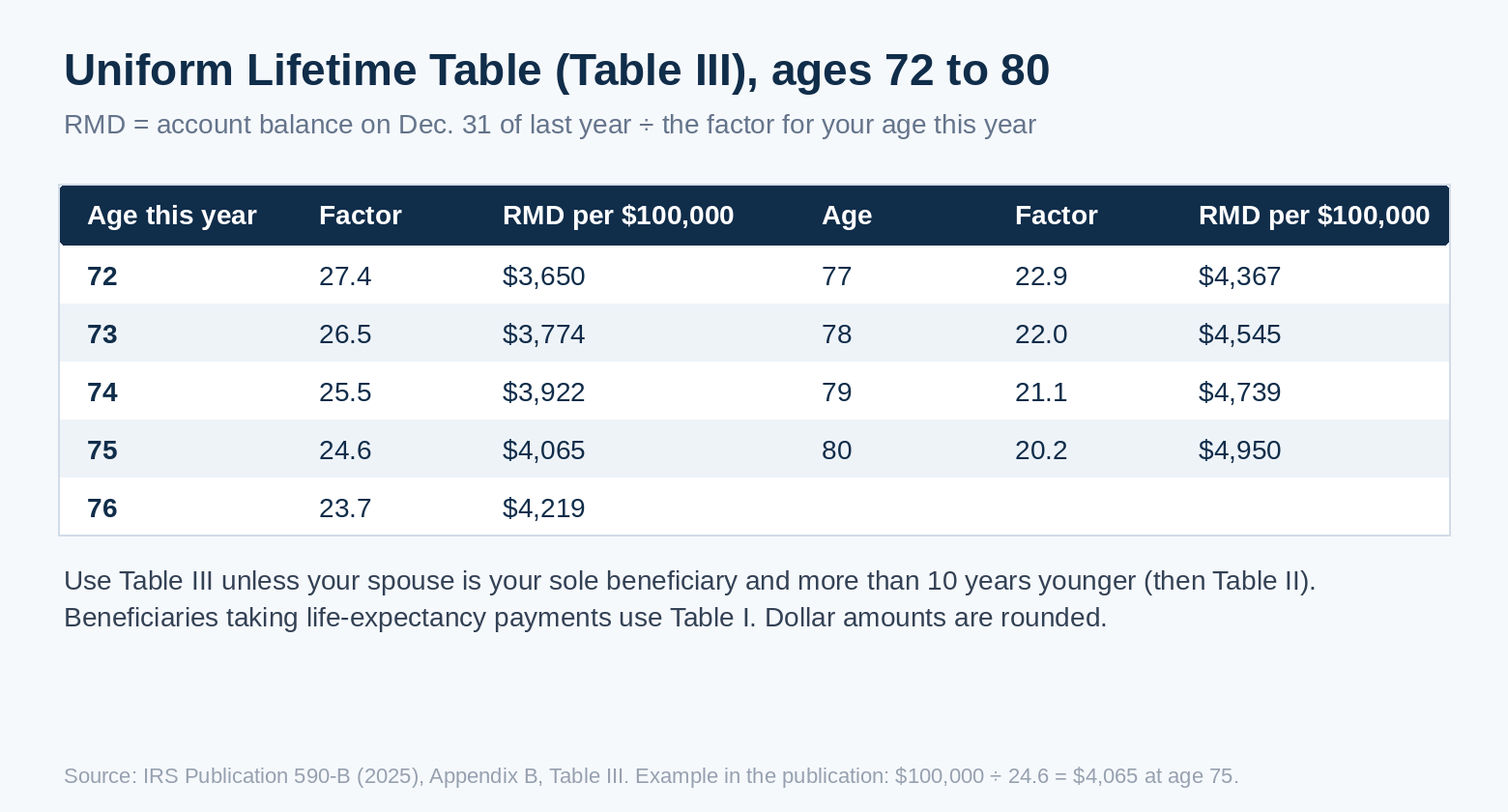
- Table III (Uniform Lifetime) is the one most IRA owners use. It applies if you are unmarried, if your spouse is not more than 10 years younger than you, or if your spouse is not the sole beneficiary.
- Table II (Joint and Last Survivor) is for owners whose spouse is the sole beneficiary and more than 10 years younger. It gives a larger divisor, so the required withdrawal is smaller.
- Table I (Single Life Expectancy) is for beneficiaries who take payments from an inherited IRA over a life expectancy.
How to figure an RMD with Publication 590-B
- Find last year’s ending balance. For a 2026 RMD, use the IRA’s value at the end of 2025.
- Find your factor. Look up your age as of your birthday in 2026 in the right table (usually Table III).
- Divide. The balance divided by the factor is your RMD for the year.
The publication’s own example: an owner with a $100,000 IRA at the end of 2025 who turns 75 in 2026 uses a factor of 24.6, so the 2026 RMD is $4,065. If the owner’s spouse is the sole beneficiary and is 11 years younger (64 in 2026), Table II gives a factor of 25.3 and an RMD of $3,953.
Your IRA custodian must either tell you your RMD or offer to calculate it, by January 31 of the year it is due. You are still responsible for taking the right amount. See how withdrawals change your balance over time with our retirement savings calculator, and check whether your savings cover your spending with how much do you need to retire.
The key rules, in plain English
When RMDs start
For traditional IRAs, your first RMD is due by April 1 of the year after you reach age 73. Every later RMD is due by December 31. Waiting until April 1 for the first one means taking two RMDs in the same year. Roth IRA owners never have to take RMDs during their lifetime. Our RMD guide goes deeper on which accounts are covered.
Missing an RMD
If you take out less than required, the shortfall can face a 25% excise tax. It drops to 10% if you take the missed amount and report it within the “correction window” the publication describes. You report it on Form 5329.
Withdrawals before 59½
Traditional IRA money taken out before age 59½ is usually hit with a 10% additional tax on top of regular income tax. Publication 590-B lists the exceptions, including:
- unreimbursed medical expenses above 7.5% of your adjusted gross income;
- health insurance premiums during a period of unemployment;
- total and permanent disability, or a certified terminal illness;
- distributions to the beneficiary of a deceased IRA owner;
- a series of substantially equal periodic payments;
- qualified higher education expenses;
- up to $10,000 toward buying, building or rebuilding a first home;
- a qualified birth or adoption distribution, and certain emergency personal expenses.
Inherited IRAs
If the owner died in 2020 or later, most non-spouse beneficiaries must empty the account by the end of the 10th year after the year of death. Spouses and other “eligible designated beneficiaries” have more options. Our inherited IRA rules guide walks through each case, all drawn from this same publication.
Giving IRA money to charity
Once you are at least 70½, a qualified charitable distribution (QCD) sent straight from your IRA to a charity is not taxed and counts toward your RMD. The annual limit is $108,000 for 2025 and $111,000 for 2026, per the publication’s QCD worksheets.
Withdrawing property instead of cash
You can take a distribution of investments (an “in-kind” distribution) instead of cash. For a Roth IRA, the publication says your basis in property you take out is its fair market value on the date of the distribution. For a traditional IRA, the value you take out is taxed like a cash withdrawal, so ask your custodian how they value it on Form 1099-R.
How to read your Form 1099-R
Each year you take money out, your IRA custodian sends Form 1099-R. Publication 590-B explains the codes in box 7. For example, code 1 means an early distribution with no known exception, and code 2 means an early distribution where an exception applies. If a code looks wrong, ask the custodian before you file.
Where to go next
The official text is linked from our directory’s IRS Publication 590-B listing, along with the IRS RMD FAQs and the rollovers and RMDs resources. If you are deciding how to draw down several accounts in a tax-smart order, our retirement planning in your 60s guide covers withdrawal order. For a large IRA, an inherited account or a trust beneficiary, a fee-only fiduciary or tax professional is worth the cost.
Common questions
What is IRS Publication 590-B?
The IRS guide to taking money out of traditional and Roth IRAs, including RMDs, inherited IRAs and penalties. The current edition is for 2025 returns.
What is the difference between Publication 590-A and 590-B?
590-A is about putting money in (contributions). 590-B is about taking money out (distributions).
Where are the life expectancy tables?
In Appendix B: Table I (single life), Table II (joint and last survivor) and Table III (Uniform Lifetime).
How do I calculate my RMD using Publication 590-B?
Divide last year’s ending balance by the factor for your age this year. At 75 the Table III factor is 24.6, so $100,000 gives a $4,065 RMD.
Does Publication 590-B cover inherited IRAs?
Yes, including the 10-year rule, spouse options and inherited Roth IRAs.
What is the QCD limit?
$108,000 for 2025 and $111,000 for 2026, and you must be at least 70½.
Sources
- IRS Publication 590-B (2025) — Distributions from Individual Retirement Arrangements (chapters, Appendix B tables, RMD examples, early-distribution exceptions, QCD limits, excise tax)
- IRS Publication 590-A — Contributions to IRAs
- IRS — Retirement plan and IRA RMD FAQs
Try it: RMD Calculator
Work out a required minimum distribution from your balance and age. Everything runs in your browser, and nothing you type is sent anywhere.
Estimates only, based on the numbers you enter. Open the full RMD Calculator or see all calculators.

Comments
No comments yet — be the first to share your thoughts.
Sign in or create an account to comment.