 Data & limits
IRS Publication 554: Tax Guide for Seniors, Explained (2025-2027)
IRS Publication 554, “Tax Guide for Seniors,” explains the federal tax rules that change once you reach 65. The main ones are a higher income threshold before you must file, a larger standard deduction, the new enhanced deduction for seniors (up to $6,000 per person for 2025 through 2028), the rules for taxing Social Security, and the credit for the elderly or the disabled. The current edition is for 2025 returns. This guide summarizes it in plain English and adds the 2026 and 2027 figures the IRS has since released.
Who counts as “65 or older”?
For tax purposes you are 65 at the end of the year if your 65th birthday is on or before January 1 of the next year. For 2025 returns, that means anyone born before January 2, 1961. A January 1 birthday counts for the earlier year.
Do you have to file? The 2025 thresholds
Publication 554’s Table 1-1 lists how much gross income you can have before you must file a 2025 return. The thresholds are higher once you are 65:
| Filing status (2025) | Under 65 | 65 or older |
|---|---|---|
| Single | $15,750 | $17,750 |
| Head of household | $23,625 | $25,625 |
| Married filing jointly | $31,500 (both under 65) | $33,100 (one 65+) / $34,700 (both 65+) |
| Married filing separately | $5 at any age | |
Social Security benefits generally do not count toward gross income for this test, unless half of your benefits plus your other income (including tax-exempt interest) is more than $25,000 ($32,000 if married filing jointly), or you are married filing separately and lived with your spouse. Even if you don’t have to file, filing can get you a refund of tax that was withheld.
Your standard deduction after 65
If you don’t itemize, you get the regular standard deduction plus an extra amount for being 65 or older (and another extra amount if you are blind):
| Tax year | Standard deduction (single / married filing jointly / head of household) | Extra amount at 65+ |
|---|---|---|
| 2025 | $15,750 / $31,500 / $23,625 | $2,000 if single or head of household; $1,600 per eligible spouse if married |
| 2026 | $16,100 / $32,200 / $24,150 | $2,050 if unmarried; $1,650 if married |
| 2027 | $16,600 / $33,200 / $24,925 | $2,100 if unmarried; $1,700 if married |
The 2025 figures are from Publication 554. The 2026 figures come from Revenue Procedure 2025-32 and the 2027 figures from Revenue Procedure 2026-35. Publication 554’s example: a married couple, both over 65, who don’t itemize have a 2025 standard deduction of $34,700 ($31,500 plus $1,600 × 2).
The enhanced deduction for seniors (2025 through 2028)
New for 2025, taxpayers 65 or older may also claim an enhanced deduction for seniors of up to $6,000 per person ($12,000 for a married couple if both qualify). It applies for tax years 2025 through 2028 and is on top of the higher standard deduction above. Key points from Publication 554 and the IRS eligibility notice:
- You can claim it whether you take the standard deduction or itemize.
- It is reduced once your modified adjusted gross income passes $75,000 ($150,000 if married filing jointly).
- You need a valid Social Security number, and married couples must file jointly to claim it.
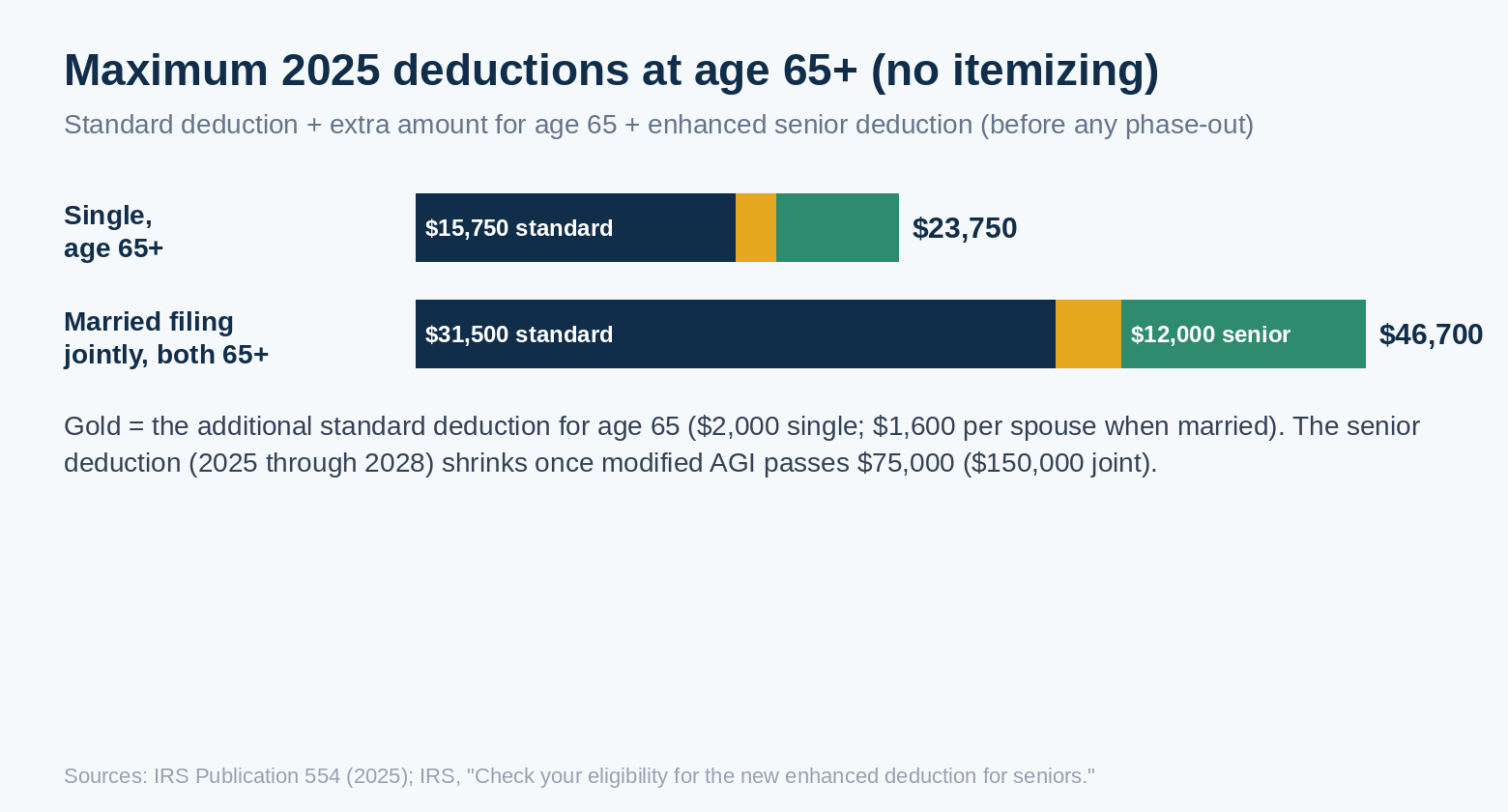
Put together, a single filer 65 or older with modified AGI under $75,000 could deduct up to $23,750 for 2025 without itemizing ($15,750 + $2,000 + $6,000). A married couple filing jointly, both 65 or older and under the $150,000 threshold, could deduct up to $46,700.
Is your Social Security taxable?
Publication 554 uses a simple first test: add half of your Social Security benefits to all your other income, including tax-exempt interest. Compare the total with your base amount:
- $25,000 if you are single, head of household, or a qualifying surviving spouse (or married filing separately and lived apart all year);
- $32,000 if you are married filing jointly;
- $0 if you are married filing separately and lived with your spouse at any time during the year.
If the total is above your base amount, part of your benefits may be taxable. Usually no more than 50% of benefits is taxable, but up to 85% can be if the total is above $34,000 ($44,000 if married filing jointly). The SSA explains the same rules on its income taxes on your benefits page, and our guide on when to claim Social Security shows how claiming age changes the benefit itself.
You can have federal tax withheld from Social Security by filing Form W-4V with the SSA, which can save you from making quarterly estimated payments.
Other income Publication 554 covers
- Pensions and annuities: generally taxable, except the part that is a return of after-tax money you put in.
- IRA withdrawals: traditional IRA distributions are taxable income. Required minimum distributions start by April 1 of the year after you reach 73. Our guide to IRS Publication 590-B covers the RMD tables and rules.
- Selling your home: part or all of the gain may be excluded if you meet the ownership and use tests.
- Medical expenses: if you itemize, Medicare Part B and Part D premiums count as medical expenses.
The credit for the elderly or the disabled
This credit (claimed on Schedule R) is for U.S. citizens or resident aliens who were 65 or older at the end of the year, or younger people who retired on permanent and total disability and had taxable disability income. It has income limits that are fairly low, so it mainly helps people with modest income and little nontaxable Social Security or pension income. Publication 554’s Figures 5-A and 5-B walk through whether you qualify.
Forms and free help for seniors
- Form 1040-SR is an optional version of Form 1040 for people 65 or older, with larger print. The math is the same.
- Tax Counseling for the Elderly (TCE) offers free tax help, particularly for taxpayers 60 and older, and VITA sites help lower-income filers. AARP Foundation Tax-Aide is another free option.
Plan the tax side of retirement
Taxes are one of the bigger expenses in retirement, so build them into your budget. Our how much do you need to retire calculator lets you include taxes in your spending, and the retirement savings calculator shows how long your savings last. For which states tax retirement income, see our best states to retire guide. The official publication is linked from our directory’s IRS Publication 554 listing and the taxes in retirement resources. If your situation is complex (a business, large IRA withdrawals, or Roth conversions), a tax professional or a fee-only fiduciary can help.
Common questions
What is IRS Publication 554?
The IRS’s Tax Guide for Seniors: filing thresholds, deductions, Social Security taxation and credits for older taxpayers, currently for 2025 returns.
How much can a senior earn before filing a tax return in 2025?
$17,750 of gross income for a single filer 65 or older; $33,100 for a married couple filing jointly with one spouse 65+, or $34,700 if both are.
What is the standard deduction for seniors over 65?
For 2025: $17,750 for a single filer 65+, and $34,700 for a married couple if both are 65+. The $6,000 senior deduction can be added on top.
What is the $6,000 senior deduction?
A deduction of up to $6,000 per person 65 or older for 2025 through 2028, reduced above $75,000 of modified AGI ($150,000 joint).
Is Social Security taxable after 65?
It can be. Up to 50% is taxable above $25,000 ($32,000 joint) and up to 85% above $34,000 ($44,000 joint), using half your benefits plus other income.
Sources
- IRS Publication 554 (2025) — Tax Guide for Seniors (filing thresholds, 2025 standard deduction and 65+ amounts, enhanced senior deduction, Social Security base amounts, credit for the elderly or the disabled)
- IRS — Check your eligibility for the new enhanced deduction for seniors (2025 through 2028, phase-out thresholds)
- IRS Revenue Procedure 2025-32 (2026 standard deduction and additional amount for the aged)
- IRS Revenue Procedure 2026-35 (2027 standard deduction and additional amount for the aged)
- IRS Publication 915 — Social Security and Equivalent Railroad Retirement Benefits
Try it: Retirement Savings Projection
See what your savings could grow to by the age you want to retire. Everything runs in your browser, and nothing you type is sent anywhere.
Estimates only, based on the numbers you enter. Open the full Retirement Savings Projection or see all calculators.

Comments
No comments yet — be the first to share your thoughts.
Sign in or create an account to comment.