 The basics
What Is the PBGC? How Pension Insurance Works (2026 Limits)
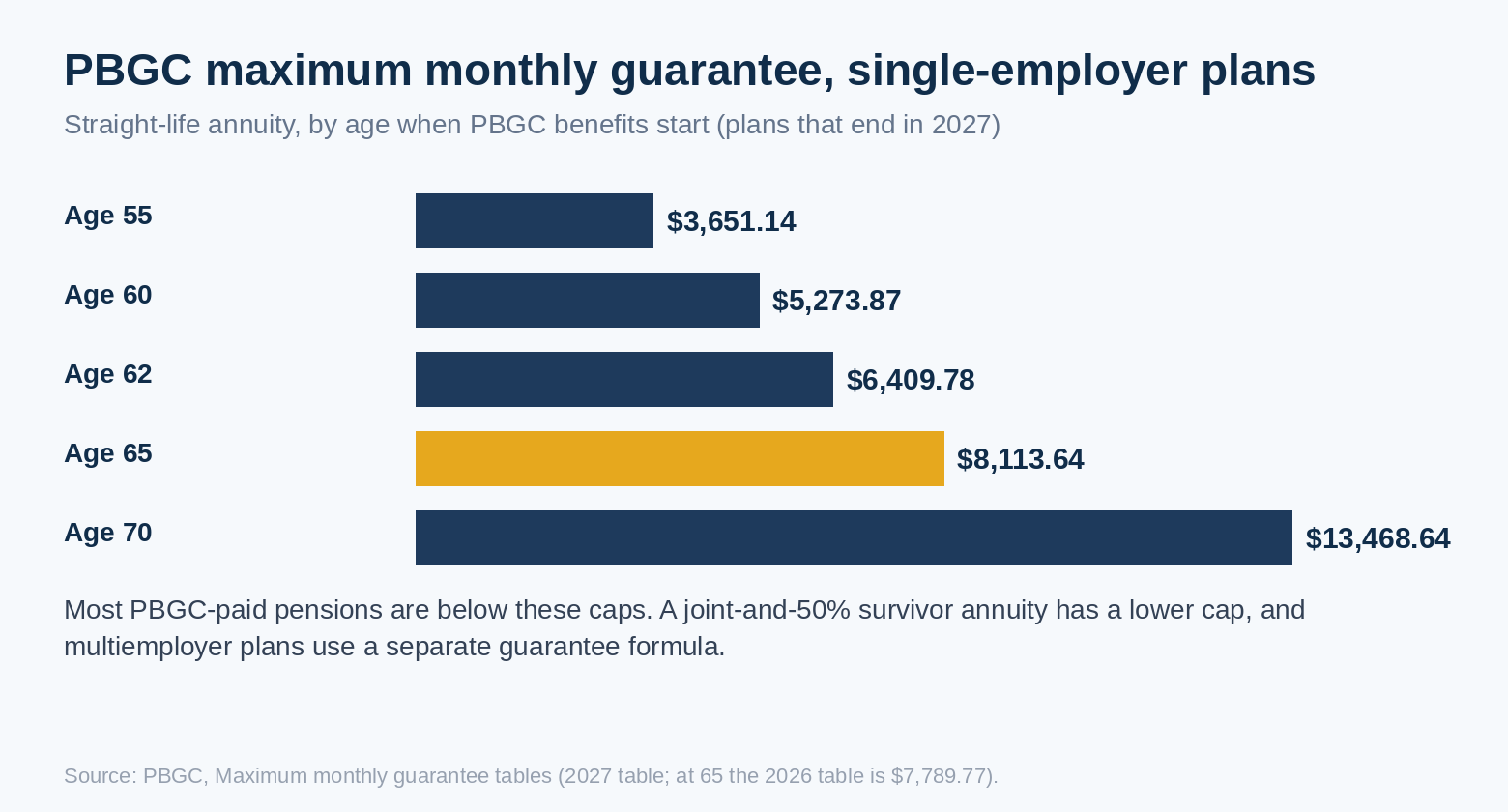
The Pension Benefit Guaranty Corporation (PBGC) is the federal agency that insures traditional private-sector pensions. If a company pension plan ends without enough money to pay what it promised, PBGC steps in and pays benefits up to limits set by law. For single-employer plans that end in 2026, the maximum guarantee for someone who starts benefits at 65 is $7,789.77 a month as a straight-life annuity; for plans that end in 2027 it is $8,113.64. Most retirees in failed plans get their full pension, because most benefits are below those caps.
What PBGC is and who runs it
PBGC was created by the Employee Retirement Income Security Act of 1974 (ERISA). Its job, in its own words, is to encourage private employers to keep their defined benefit pension plans, to keep pension payments flowing without interruption, and to keep pension insurance premiums low. It is headed by a director appointed by the president and confirmed by the Senate, and its board is made up of the Secretaries of Labor, Commerce and Treasury.
PBGC says it protects the retirement income of about 30 million American workers, retirees and their families.
Which pensions PBGC covers
PBGC insures private-sector defined benefit pensions, the kind that pay a set monthly amount at retirement. It runs two separate insurance programs:
| Program | Who it protects | How PBGC helps if a plan fails |
|---|---|---|
| Single-employer program | About 18.4 million workers and retirees in about 22,200 plans | PBGC takes over the plan and pays benefits directly, up to legal limits |
| Multiemployer program (union plans with several employers) | About 11.1 million workers and retirees in about 1,300 plans | PBGC lends money to the plan, and the plan keeps paying benefits up to legal limits |
A 401(k), 403(b) or IRA is a different kind of plan (a defined contribution account, where your balance is your benefit), so it is not part of PBGC’s insurance. Pensions run by federal, state or local governments are also outside these private-sector programs. If you’re not sure what kind of plan you have, our guide to which retirement plan each type of worker gets can help.
How PBGC is paid for
According to PBGC, the single-employer program is financed by insurance premiums that plan sponsors pay, investment income, and assets and recoveries from failed plans. Congress sets the premium rates. The multiemployer program is financed by premiums and investment income. The one exception is Special Financial Assistance for troubled multiemployer plans, created by the American Rescue Plan Act of 2021, which is paid for with general taxpayer funds. The two programs are kept legally and financially separate.
In fiscal year 2025, PBGC paid monthly retirement benefits to nearly 926,000 retirees in more than 5,000 single-employer plans that had ended.
The maximum guarantee
When PBGC takes over a single-employer plan, it guarantees the “basic benefits” you earned before the plan’s termination date, up to a yearly maximum set under ERISA. The cap depends on two things:
- The year the plan ended (or the year your employer filed for bankruptcy, if the plan ended during a bankruptcy).
- Your age when PBGC benefits start, and the form of annuity. The cap is lower at younger ages, because you are expected to receive more monthly checks, and lower for annuities with survivor benefits.
| Age benefits start | 2026 table: straight-life | 2026 table: joint and 50% survivor | 2027 table: straight-life |
|---|---|---|---|
| 55 | $3,505.40 | $3,154.86 | $3,651.14 |
| 60 | $5,063.35 | $4,557.02 | $5,273.87 |
| 62 | $6,153.92 | $5,538.53 | $6,409.78 |
| 65 | $7,789.77 | $7,010.79 | $8,113.64 |
| 67 | $9,425.62 | $8,483.06 | $9,817.50 |
| 70 | $12,931.02 | $11,637.92 | $13,468.64 |
All amounts are monthly, from PBGC’s maximum monthly guarantee tables. These caps apply only to single-employer plans that PBGC pays as trustee; multiemployer plans use a separate guarantee formula.
Other limits to know
- PBGC generally won’t guarantee a monthly amount larger than the benefit your plan would have paid at its normal retirement age.
- Benefit increases added within five years before the plan ended may not be fully guaranteed.
- People who qualified for a disability pension before the plan ended have higher limits.
What happens if your pension plan fails
- You get a letter saying PBGC is now responsible for your pension, with a Payee Information Form to return.
- PBGC reviews the plan’s records. Until that review is done, which PBGC says typically takes two to three years, retirees receive estimated benefits. The final amount can differ, and you can appeal PBGC’s determination.
- If you haven’t retired yet, PBGC suggests requesting an estimate four months before you want benefits and applying through its online MyPBA service three months before. Payments start about three months after you contact PBGC. Its customer contact center is 1-800-400-7242.
Before a plan is taken over, PBGC usually has no information about you. Your records stay with the employer that promised the pension, so questions about a plan that is still running go to the plan administrator.
What this means for your retirement plan
A private-sector pension in an insured plan is a fairly secure income source, and PBGC protection is one reason. Still, a few habits help:
- Keep your own records of pension statements, plan names and employer contacts, especially for jobs you left long ago.
- Compare payout options carefully at retirement. A joint-and-survivor annuity pays less each month but protects a spouse. Our retirement planning in your 60s guide covers pension elections.
- Count the pension in your income plan. Enter it as guaranteed income in our how much do you need to retire calculator, and see how long your other savings last with the retirement savings calculator.
- Coordinate it with Social Security. A pension can make it easier to delay claiming. See when to claim Social Security, and for how pension income is taxed, our guide to IRS Publication 554.
Official resources are linked from our directory’s PBGC listing, the U.S. Department of Labor retirement plans page and the pensions and PBGC section. If you are choosing between a lump sum and an annuity, a fee-only fiduciary can model both for your situation.
Common questions
What is the PBGC?
A federal agency, created by ERISA in 1974, that insures private-sector defined benefit pensions and pays benefits up to legal limits when an insured plan fails.
What is the PBGC maximum guarantee?
For single-employer plans ending in 2026, $7,789.77 a month at 65 (straight-life). For plans ending in 2027, $8,113.64. Lower at younger ages and with survivor benefits.
Does PBGC insure 401(k) plans?
No. It insures pensions that pay a set monthly amount, not account-based plans like 401(k)s.
Is PBGC funded by taxpayers?
Mostly not. Premiums, investment income and recoveries pay for its programs; Special Financial Assistance for some multiemployer plans uses taxpayer funds.
What happens to my pension if my company goes bankrupt?
If PBGC takes over the plan, it pays your benefit up to the legal limits, starting with estimated payments while it reviews the plan.
Sources
- PBGC — Who we are (ERISA 1974, mission, board, about 30 million covered)
- PBGC — How PBGC operates (two programs, financing, plan counts, FY 2025 payments, what happens when a plan is trusteed)
- PBGC — Maximum monthly guarantee tables (2026 and 2027 tables)
- PBGC — Guaranteed benefits (basic benefits, five-year phase-in, disability)
Try it: Pension Lump Sum vs. Monthly Calculator
Compare a lump-sum offer with the monthly pension over the years you expect to collect. Everything runs in your browser, and nothing you type is sent anywhere.
Estimates only, based on the numbers you enter. Open the full Pension Lump Sum vs. Monthly Calculator or see all calculators.

Comments
No comments yet — be the first to share your thoughts.
Sign in or create an account to comment.