 Careers
Retirement Planning for Dental Hygienists (2026): Plans, Limits & Part-Time Rules
Dental hygienists earn good money, but many don't get a strong retirement plan with the job. The U.S. Bureau of Labor Statistics (BLS) puts the median hygienist wage at $98,100 a year (May 2025). It also reports that 94% of hygienists work in dentists' offices, that many work part time, and that benefits "may be available only to full-time workers" (BLS Occupational Outlook Handbook). Small offices, part-time schedules and temping between practices all make it more likely that you'll have to build your own retirement plan. This guide shows you how, with the 2026 limits.
Why hygienists are often on their own
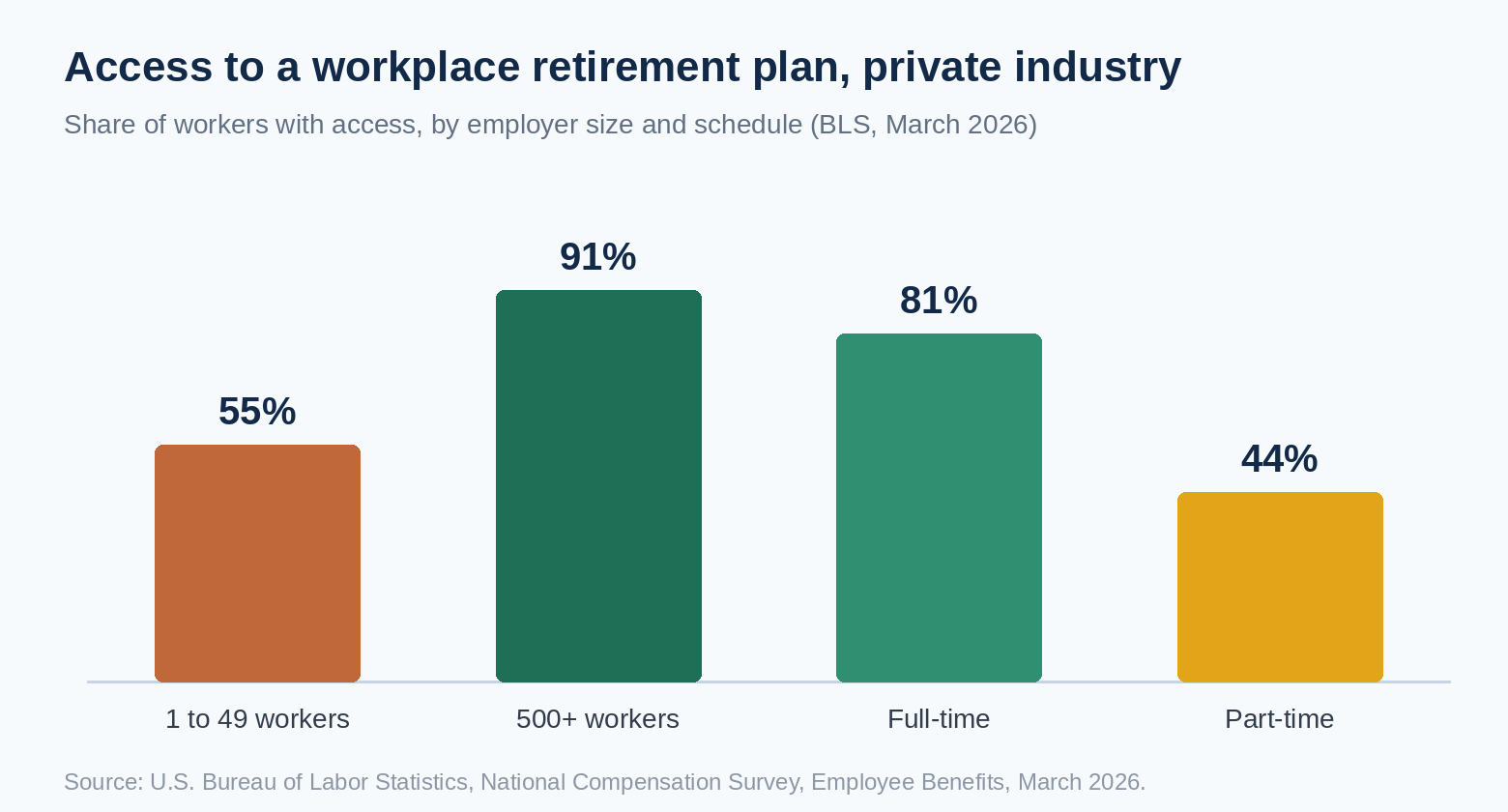
Most dental offices are small businesses, and small employers are much less likely to offer a retirement plan. In the BLS National Compensation Survey for March 2026, 55% of private-industry workers at places with 1 to 49 workers had access to a retirement plan, compared with 91% at places with 500 or more. Schedule matters too: 81% of full-time workers had access, but only 44% of part-time workers (BLS Employee Benefits, Table 1).
Many hygienists are small-office and part-time workers at once. If that's you, don't wait for a plan to show up. Use the steps below.
Which plan does your office offer?
Ask the office manager one question: "Do we have a retirement plan, and which kind?" The answer usually falls into one of these:
| What the office has | Your 2026 limit | What to know |
|---|---|---|
| 401(k) | $24,500 of your pay, plus $8,000 at 50+ ($11,250 at 60–63) | More common at larger groups and dental support organizations (DSOs). Get the full match first. |
| SIMPLE IRA | $17,000, plus $4,000 at 50+ ($5,250 at 60–63) | Common in small offices. The employer must put in a match or a fixed contribution. |
| SEP IRA | Employer contributions only | Only the dentist contributes through the SEP; there are no payroll deferrals. You can still make your own regular IRA contribution. |
| Nothing | IRA: $7,500, plus $1,100 at 50+ | Open your own IRA. If you have 1099 income, a Solo 401(k) can hold much more. |
Limits are from the IRS 2026 announcement. For every account and the income rules, see our 2026 contribution limits guide.
One SIMPLE IRA trap: if you take money out within two years of first joining the plan, the extra early-withdrawal tax is 25%, not the usual 10%. During those two years you can only move the money to another SIMPLE IRA without it counting as a withdrawal (IRS SIMPLE IRA withdrawal rules). If you change offices often, leave a new SIMPLE IRA alone for its first two years.
If you work part time
Part-time hygienists used to be left out of many 401(k) plans. A newer rule helps: for plan years that start after 2024, a 401(k) generally can't exclude a worker who has at least 500 hours of service in each of two straight 12-month periods. These "long-term part-time" employees must be allowed to put their own pay into the plan, though the employer doesn't have to match it (IRS Notice 2024-73). If you've worked two or three days a week at the same office for two years, ask whether you're now eligible.
If a part-time schedule leaves you with little or no earned income, a married couple can still fund an IRA for the lower-earning spouse using the other spouse's earnings, as long as they file jointly (IRS Publication 590-A, "Kay Bailey Hutchison Spousal IRA").
If you temp or work at several offices
Temping through an agency usually means W-2 pay, so check whether the agency has a plan. If offices pay you as an independent contractor (a 1099), you count as self-employed for that income. A Solo 401(k) then lets you contribute as both the "employee" (up to $24,500 in 2026) and the "employer," up to a $72,000 total per plan (IRS Notice 2025-67). The employer part is limited to a share of your net self-employment earnings (IRS Publication 560).
Watch the shared limit. The $24,500 employee limit covers all your 401(k), 403(b) and SIMPLE deferrals together. If you put money into an office 401(k) and a Solo 401(k) in the same year, your combined employee contributions can't go over it.
Roth or traditional IRA?
If you aren't covered by a plan at work (and you're single, or your spouse isn't covered either), your traditional IRA contribution is fully tax-deductible no matter what you earn. A Roth IRA gives you no deduction now but tax-free withdrawals later. For 2026 the Roth IRA phases out between $153,000 and $168,000 of income for single filers and $242,000 to $252,000 for married couples filing jointly (IRS). Our Roth vs. traditional guide walks through the choice.
Part-time hygienists with lower household income should also check the Saver's Credit. For 2026 the income limits are $40,250 for single filers, $60,375 for heads of household and $80,500 for married couples filing jointly (IRS).
How much room do you have?
Put the numbers together. In a small office with a SIMPLE IRA, you could defer $17,000 and also put $7,500 in your own IRA, for $24,500 in 2026. That's about a quarter of the $98,100 median wage, before any employer match. With no plan at all, the IRA's $7,500 is the starting point, which is why the 1099 and part-time options above matter so much.
To see what you actually need, start with our how much do you need to retire calculator. Then plug your real monthly savings into the retirement savings calculator to see if you're on pace.
Plan for a body that may want to stop early
BLS notes that hygienists "work in tight spaces on a small part of the body." Years of that can make a full five-day schedule hard to keep up into your 60s. Many hygienists plan to cut days before they fully retire. Plan for it on purpose:
- Test an earlier date. Run your numbers at 60 as well as 65 in the savings goal calculator. Fewer working years means more years to fund.
- Know which money you can reach before 59½. The age-55 exception applies to a 401(k) you leave in or after the year you turn 55, but it does not apply to IRAs, SEP IRAs or SIMPLE IRAs (IRS exceptions). Most hygienists' money sits in IRAs, so a taxable brokerage account or Roth IRA contributions can act as the bridge.
- Price health insurance before 65. It's often the biggest cost of leaving early. Our early retirement guide covers the bridge years.
- Ask about disability coverage. If an injury ends your clinical career, disability insurance replaces income; your retirement savings shouldn't have to.
Your checklist
- Ask your office which plan it offers (401(k), SIMPLE IRA, SEP or none) and what it puts in for you.
- Contribute at least enough to get the full match or employer contribution.
- Open your own IRA and automate a monthly transfer, even a small one.
- If you have 1099 income, look at a Solo 401(k).
- Part time for two years or more at one office? Ask if you're now eligible for its 401(k).
- Re-run your numbers each year, and use catch-up contributions from age 50.
Working in a hospital, public clinic or school instead? See our broader guide to retirement planning for nurses and healthcare workers, which covers 403(b), 457(b) and pension plans.
Common questions
Do dental hygienists get a 401(k)?
Some do, mostly at larger groups and DSOs. Many small offices offer a SIMPLE IRA or SEP IRA instead, and some offer nothing. BLS data show only 55% of workers at employers with fewer than 50 workers had access to any retirement plan in March 2026.
What retirement plan should a part-time dental hygienist use?
Use the office plan if you're eligible, and open your own IRA either way. If you've worked at least 500 hours a year at the same office for two years in a row, its 401(k) generally has to let you contribute.
Can a 1099 dental hygienist open a Solo 401(k)?
Yes. Independent-contractor income counts as self-employment, so you can contribute as employee and employer, up to $72,000 total for 2026. Your employee share is shared with any other 401(k), 403(b) or SIMPLE deferrals.
How much can a dental hygienist put in a SIMPLE IRA in 2026?
$17,000, plus $4,000 if you're 50 or older, or $5,250 at ages 60 to 63.
Can I retire early as a dental hygienist?
Yes, with a plan for the bridge years. The age-55 rule only covers 401(k)-type plans, not IRAs, so most hygienists need taxable savings or Roth contributions to cover the years before 59½, plus a plan for health insurance before 65.
Sources
- BLS — Occupational Outlook Handbook: Dental Hygienists (pay, work settings, benefits)
- BLS — Employee Benefits in the United States, March 2026, Table 1
- IRS — 2026 retirement plan and IRA limits
- IRS Notice 2025-67 (total defined-contribution limit)
- IRS Notice 2024-73 (long-term, part-time employees)
- IRS — SIMPLE IRA withdrawal and transfer rules
- IRS Publication 560 (retirement plans for the self-employed)
- IRS Publication 590-A (IRA contributions, spousal IRA)
- IRS — Exceptions to tax on early distributions

Comments
No comments yet — be the first to share your thoughts.
Sign in or create an account to comment.